Anne Frank


1929 - 1945


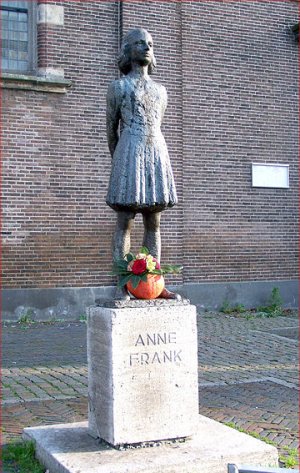
Statue of Anne Frank
Statue Anne Frank in Utrecht, made by Pieter d'Hont in 1959 and placed
in 1960 at the Janskerkhof. Photo by Wikipedia user Brbbl

Anne Frank was born to Otto Frank and his wife Edith on June 12, 1929. They named her Annelies Marie. She had a sister Margot who was three years older. They were a Jewish family living in Germany. Their families had lived in Germany for centuries.

By 1932 Adolph Hitler had risen to power in Germany and instead of enjoying a democracy, the German people now suffered under the rule of a dictator. Hitler blamed the Jews for all the problems in the country. Otto realized it was becoming unsafe for his family in Germany and moved them to the Netherlands. He set up a company in Amsterdam making a product that the women used to make homemade jam. It was called Opekta. (Pectin * is derived from fruits and will cause jelly and jam to jell. In America you can buy a pectin product called Sure Jell .)

The family was safe for a while, but then in 1940 the Germans invaded the Netherlands and began to arrest and persecute the Jews there. They put restrictions on the Jews and made them wear an identifying yellow star on their clothes. They could not own a business. They could not ride a bicycle. Life became very hard, and the Jews feared for their lives.


Margot, Anne's sister was called to report to a work camp in Germany. The family had been planning a hiding place, but with Margot's call-up they knew they had to hide immediately. And so they did. The date was July 6, 1942.

The hiding place became known as the Secret Annex. It was located at 263 Prinsengracht. The Frank family would occupy two rooms on the first floor. A week later Mr. and Mrs. Van Pels and their son would move into the two rooms on the second floor. From Peter's tiny room they could access the attic where food was stored. There was a small bathroom on the first floor.

The first thing they did was make curtains to prevent anyone from seeing in. An eighth person, Fritz Pfeffer, an older man, a dentist, arrived in November and would share a room with Anne.

Father Voskuijl made a movable bookcase to hide the door through which they entered their quarters.

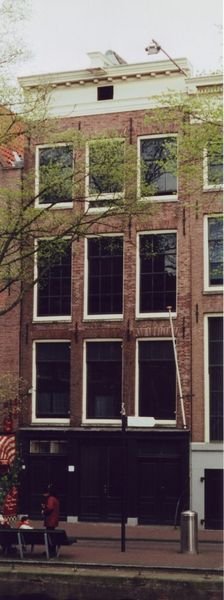
This picture shows the streetside view of the building. Otto Frank's offices were at the front of the building and the hiding place was at the rear.
There were four people who helped them during the two years and 30 days they were in hiding. Miep Gies, Victor Kugler, Johannes Kleiman and Bep Voskuijl provided food for them, and at great personal risk to their own lives visited daily and brought news from the outside world.

The people in hiding must be very quiet when the warehouse workers are at work downstairs. They can move around when the men are gone for lunch, and at 5:30 in the afternoon when the workers leave the building Anne and the others are free to go downstairs into the office area. Anne calls it their "nightly freedom".

The Franks had brought school books for an extended stay and library books are brought to the group weekly. They spend a lot of time reading, studying, and working correspondence courses.

Anne writes in her diary*. She creates an imaginary friend "Kitty" with whom she shares her innermost thoughts in her writings. Sometimes she writes short stories. After hearing on a radio broadcast that there would be a collection of the diaries and writings made during the war, Anne begins to think about making her writings into a book. After a lot of thought she decides she will call it "Achterhuis" (Secret Annex).
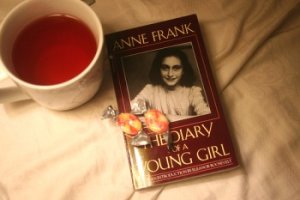

Anne Frank diary first published in 1947

She begins rewriting her entries, leaving out some very personal items she would rather not share. For over two months she works rewriting her diaries.

On August 4, 1944 the people in hiding were discovered. Someone, they never found out who, betrayed them and a Secret Service officer and three men of the Dutch police force came up the stairs, entered with guns, and herded them away to jail. The two men who had been helping them were also arrested and taken to the city prison. The two women helpers, Miep and Bep, were left behind. They went into Anne's small room. Her diaries were scattered all over the floor. They collected them and Miep kept them.

The eight people are taken to a transit camp, Westerbork. From that camp people are taken to extermination and concentration camps *. During the month they are there they have to break up old batteries. On September 2, 1944 their names appear on the list of people to be moved. They are put on freight cars and three days later they arrive at the Auschwitz-Birkenau concentration camp. The people in the freight cars were divided. Men and women were separated and then they were divided into groups; one group would go to labor camps, and those who could not work would be killed in the gas chamber.

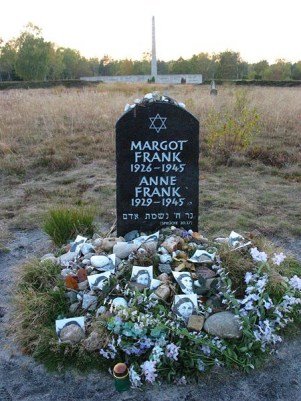
By the end of October Anne and her sister Margot are transferred to another camp, Bergen-Belsen. They both become ill there and died of typhus in March of 1945. They died just a few weeks before the British Army arrived and freed the prisoners.

The four helpers survived the war and so did Anne's father Otto Frank. He searched desperately for word of the fate of his family. Finally in July he met two sisters who witnessed the death of Anne and Margot.

After Otto learned of the death of his daughters, Miep gave him the pages of the diary she had been saving. He was surprised at the depth of her writings. This was an Anne he never knew. He honored her wish to have her writings published as a book. First the book was published in the Dutch* language, then German, French, and English. The book was made into a stage play, then into a film.

Today when you see the word "Holocaust" * it usually refers to this time in which the German Army systematically * killed nearly 6 million Jews. People need to learn about the Holocaust and the reasons why it happened, lest periods of hatred and discrimination cause a similar genocide*. Some say it never happened at all, but we know it did because there are too many witnesses and survivors who lived to tell the world about those darkest of times.

Today if you visit the site of the Bergen-Belsen concentration camp you can see a memorial to Anne Frank and her sister Margot.


A frequent question: "Who wrote this biography and when was it written?" Look on this Reference Citations Chart.


Work a Jigsaw Puzzle

Online Crossword Puzzle

Online Word Search

Online Word Scramble

Take the Test Online

Online Jeopardy

Online Biography "Who Am I?"

PRINTABLES

Anne Frank Word Search

Anne Frank Crossword Puzzle

Anne Frank - Word Scramble

Anne Frank Study Sheet

Worksheet

Print Anne Frank Test


Anne Frank
at Bio 4 Kids

Anne Frank House

Anne Frank Center - USA Website

Anne Frank, the Writer - An Unfinished Story

Anne Frank
at The Time 100

Anne Frank in the World 1929 - 1945
Teacher workbook, Utah Education Network

Anne Frank
at Wikipedia

United State Holocaust Memorial Museum
watch videos of survivors of the Holocaust

Anne Frank, the Story of a Young Girl
from Southern Methodist University

The Life of Anne Frank
a chronology

English Lesson Plan on Anne Frank

A Teacher's Guide to the Holocaust

At biography.com search for Anne Frank.
Scroll the panel for the "Video & Audio Results".


73788: The Diary of a Young Girl: Anne Frank, The Definitive Edition The Diary of a Young Girl: Anne Frank, The Definitive Edition
By Anne Frank / Random House, Inc

Restored in this Definitive Edition are diary entries that had been omitted from the original edition. These passages, which constitute 30 percent more material, reinforce the fact that Anne was first and foremost a teenage girl, not a remote and flawless symbol. She fretted about, and tried to cope with her own emerging sexuality. Like many young girls, she often found herself in disagreement with her mother. And like any teenager, she veered between the carefree nature of a child and the full-fledged sorrow of an adult. Anne emerges more human, more vulnerable, and more vital than ever.

Anne Frank and her family, fleeing the horrors of Nazi occupation, hid in the back of an Amsterdam warehouse for two years. She was thirteen when the family went into the Secret Annex, and in these pages she grows to be a young woman and a wise observer of human nature as well. With unusual insight she reveals the relations between eight people living under extraordinary conditions, facing hunger, the everpresent threat of discovery and death, complete estrangement from the outside world, and above all, the boredom, the petty misunderstandings, and the frustrations of living under such unbearable strain, in such confined quarters.

A timeless story rediscovered by each new generation, The Diary of a Young Girl stands without peer. For both young readers and adults it continues to bring to life this young woman, who for a time survived the worst horror the modern world had seen - and who remained triumphantly and heartbreakingly human throughout her ordeal. For those who know and love Anne Frank, The Definitive Edition is a chance to discover her anew. For readers who have not yet encountered her, this is the edition to cherish.


473798: Eyewitness Readers, Level 3: The Story of Anne Frank Eyewitness Readers, Level 3: The Story of Anne Frank
By Brenda Lewis / Dk Children

Anne Frank lived a secret life with her family, hiding from the Nazis. She wrote all about it in her remarkable diary. Stunning photographs combine with lively illustration and engaging, age-approriate stories in this book, a multilevel reading program guaranteed to capture children's interest while developing their reading skills and general knowledge. Level 3: Grades 2-3.

003327: Anne Frank Diary Of A Young Girl L-I-T Study Guideo 12 Anne Frank Diary Of A Young Girl L-I-T Study Guideo 12
By Educational Impressions

Inspire your students to actually think about the literature they're reading with LIT (Literature in Teaching) Guides! With titles analyzing the best of children's and classic literature, each guide includes a story summary, "meet the author" bio, pre-reading information, vocabulary, critical thinking chapter questions, creative-thinking activities, cooperative learning projects, post-reading assignments, and more. Four or five literary devices or skills such as plot, setting, irony, tone, etc. are also spotlighted in each guide. Glossary and answer key included. 48 classroom reproducible pages, softcover. Grades 5-12 .

This guide accompanies the sold-separately novel The Diary of a Young Girl by Anne Frank .


370986: Anne Frank: Diary of a Young Girl, Novel Units Teacher Gd. Gr. 7-8 Anne Frank: Diary of a Young Girl, Novel Units Teacher Gd. Gr. 7-8
By Frank / ECS Learning Systems

This Novel Units Teacher Guide is for the book Anne Frank: Diary of a Young Girl, and accompanies the Novel Units Anne Frank Student Packet.

Including a number of teacher's helps, exercises, discussion questions, assessment tools, graphic organizers, writing and art ideas, critical thinking challenges, extension activities, glossary and more, this is a convenient guide to facilitating discussion. Background information includes a summary of the book, information about the author and ideas for initiating activity; the discussion questions follow the chapters in the book. Page numbers are included, which reference the edition quoted in the front cover. [Classic Pocket Book Paperback Edition].

Answers for the questions provided in this teacher's guide are included; however, answers for the sold-separately student packet are included in the student book. 32 reproducible pages, softcover. Grades 7-8.


From Word Central's Student Dictionary
by Merriam - Webster

(Pronunciation note: the schwa sound is shown by ə)

Holocaust
'hoe-lə-cost or hau-lə-caust
Function: noun
1 : a sacrifice destroyed by fire
2 : a thorough destruction especially by fire
3 often capitalized : the killing of European civilians
and especially Jews by the Nazis during World War II

genocide
Pronunciation: 'jen-ə-side
Function: noun
the deliberate destruction of a racial, political, or cultural group

concentration camp
Function: noun
a camp where persons (as prisoners of war, political prisoners, or refugees)
are detained

systematic
Pronunciation: sis-ə-'mat-ik
Function: adjective
carried out or acting with thoroughness or regularity
sys-tem-at-i-cal-ly ,adverb

Dutch
Pronunciation: 'dəch
Function: adjective
of or relating to the Netherlands, its inhabitants, or their language

diary
Pronunciation: 'die-ə-re
Function: noun
a daily record especially of personal experiences and thoughts;
also : a book for keeping such a record

pectin
'pek-tən
Function: noun
any of various substances in plant tissues that dissolve
in water and produce a gel which is the basis of fruit jellies;
also : a commercial product rich in pectins


Page Comments

Most Recent Comments   ( See more comments on this page )
2010-01-26
remember some kids are just learning about anne and don't know what a diary is so yeah great job
devin stanley
2009-12-13
I think this was a well-written account of Anne Frank, but I don't think the definition of "diary" had to be explained.
Anonymous
2009-05-07
I just love this page,about Anne.
Lindsey Pearson

Leave a Comment       View all Comments


Biographies in this Series

Reference citations information for these biographies


Presidents of
the United States
George Washington John Adams Thomas Jefferson James Madison James Monroe Andrew Jackson
  Abraham Lincoln Theodore Roosevelt Franklin D. Roosevelt John F. Kennedy Ronald Reagan Barack Obama
American Patriots Benjamin Franklin Francis Scott Key Deborah Sampson
World Leaders Constantine Alexander the Great Winston Churchill
Inventors Alexander Graham Bell Johann Gutenberg Cyrus McCormick The Wright Brothers Henry Ford Thomas A. Edison
  Sequoyah Nikola Tesla
Explorers Christopher Columbus Meriwether Lewis Robert Peary John Muir Matthew Henson Sir Edmund Hillary
  Kit Carson "Johnny Appleseed"
Women who made
a difference
Clara Barton Helen Keller Florence Nightingale Joan of Arc Amelia Earhart Annie Oakley
  Susan B. Anthony Elizabeth Keckly Harriet Tubman Anne Frank Eleanor Roosevelt Madam C.J. Walker
Scientists George Washington Carver Sir Isaac Newton Marie Curie Louis Pasteur Albert Einstein Galileo
  Lise Meitner Norman Borlaug
Educators Noah Webster Booker T. Washington Aristotle
Physicians Hippocrates Walter Reed Albert Schweitzer
Religious Leaders Increase Mather
Athletes Lou Gehrig Wilma Rudolph Tiger Woods Michael Phelps
Civil Rights
Leaders
Martin Luther King Rosa Parks Sojourner Truth Frederick Douglass Mary Ann Shadd Cary James Forten
  Gandhi César Chávez
Composers Beethoven
Authors Laura Ingalls Wilder Samuel Clemens (Mark Twain) Ernest Hemingway
Artists John James Audubon Gutzon Borglum Ansel Adams

Home


Back to Famous Leaders


Puzzles on these pages courtesy of
Songs of Praise and Armored Penguin

Photos courtesy Wikipedia,

Photo of a replica of Anne Frank's diary courtesy of Flickr user jim 12957.

Published diary courtesy of Flickr user Badger Badger Mushroom.