JOHN JAMES AUDUBON

Artist and Naturalist*
Born April 26, 1785 - Died January 27,1851


John James Audubon
 

John James Audubon was the illegitimate* son of a sea captain, Jean Audubon and a servant girl on a sugar plantation in Haiti. His mother Jeanne Rabin died when he was not yet a year old. His father cared for him a couple of years then sent the child to France to be raised by his middle-aged wife Anne, who was fourteen years older than her husband. This selfless woman lovingly raised John and also his half-sister as her own children. She was 58 years old and provided education and nurtured the children throughout their childhood. John had a great love and respect for his step-mother.

When he was a boy he enjoyed wandering through the woods, collecting things from nature, and watching the birds. He began to draw pictures of birds and animals.

When Jean Jacques (as he was called) was eighteen years old his father either sent him or went with him to America. He was afraid the boy was going to be drafted into Napolean's army, and he wanted to get him to a safer place.

Upon arriving in America the young man changed his name to John James which sounded more like an American name. His father had set up some businesses and purchased Mill Grove farm near Philadelphia for him to oversee.

He continued to draw. He changed from the use of pastels* to watercolors. He taught himself through trial and error specializing in birds.

He met a young woman named Lucy. They married and she was a constant source of encouragement to him. He said of her, "With her, was I not always rich?" They would have four children. Their two daughters died when they were babies, but their two sons lived to adulthood. The sons, Victor and John, would become artists and help their father with the painting of the backgrounds for his birds.They were also active in the publication of his works.

When he was 35 years old he took an eight month trip down the Mississippi River to find and paint birds.

Lucy, a teacher and governess*, was able to support herself and their two sons while Audubon pursued his dream of publishing a book of drawings of birds.

Audubon was the first person to start bird-banding studies in America. He tied lightweight strings to their legs, and he could track their travels as they nested, left the area, and then returned to the nest.

He was not experiencing success in America selling his paintings, so he went to England to sell subscriptions. His clients had to subscribe to his engravings which were delivered in installments, five engravings at a time. There would be one large picture of a bird, one medium-size bird, and three small birds. The pictures were printed from copper plates then watercolored by hand. A subscription cost $1,000, which was a lot of money in the 1800's.

While in England he dressed as a woodsman and let his hair grow long. He worked long hours and painted in public so people could watch him work.

Audubon went through many financial hardships. If Lucy had not been such an independent woman, he probably could not have fulfilled his dream. He gave art lessons to support himself, and at one point even taught dancing lessons to make a little money while he looked for a publisher for his drawings.

At one point early in his career he left 200 of his bird drawings with a friend. When he returned several months later he discovered that a pair of rats had shredded his pictures to make a nest and raised a family in the box. It was such a tragic event in his life because he had spent years making the drawings. The only thing to do was start over. This is what he did, even making improvements, and within three years his bird portfolio was full again.

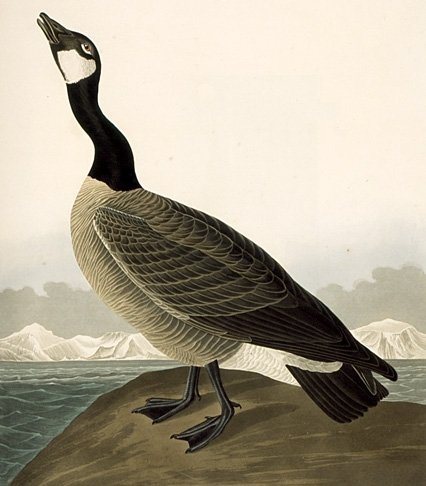
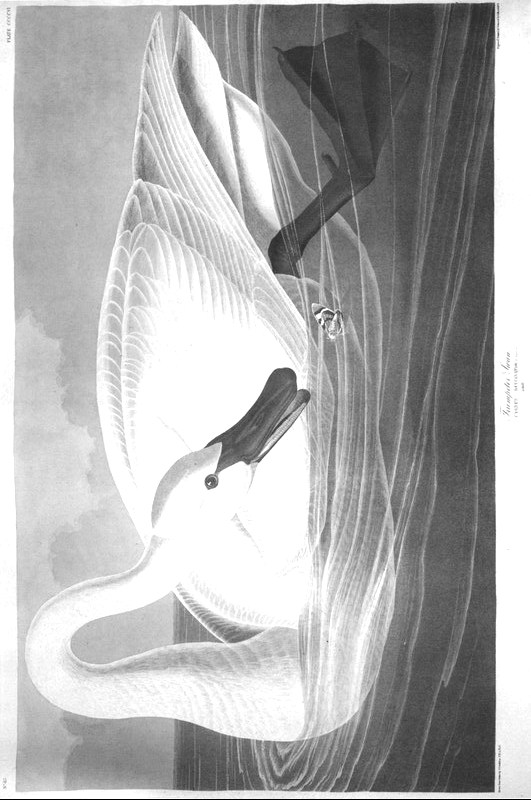
Another artist Alexander Wilson had already published a set of bird prints; American Ornithology* , but Audubon thought he could do better, and he did. His pictures were more life-like and also life size. He had them printed on large sheets of paper 22"X 28". The finished portfolio after it was leather bound was about 26 1/2"X 39". This portfolio of large prints was labeled a "Double Elephant" portfolio. It was called Birds of America. The huge leather bound books originally sold for $1,070 in 1826. Some people who bought the books would break them apart and sell the individual pages. Few of the books remained intact. In 2003 a complete leather bound four-volume set sold for over $8,000,000.

Audubon and his printer, Robert Havell, printed a smaller version called the Octavo Edition* (think "octave" or eight notes). This edition was one-eighth the size of the first edition and Audubon called it Birds in Miniature . It was 6 1/2"X 10 1/2".

He then published a large book of animal drawings, The Viviparous Quadrupeds of North America and then a smaller octavo edition.

Audubon during this period suffered a stroke, and he was also in the early stage of Alzheimer's disease*. He died four months before his 66th birthday. Lucy lived another twelve years and tried her best to support the families of their sons who had also died.

After her husband's death she started a school and one of her students loved birds just as Audubon had. George Grinnell later started the Audubon Society.

Lucy sold his original paintings for only $4,000, and she also died at the age of 87.
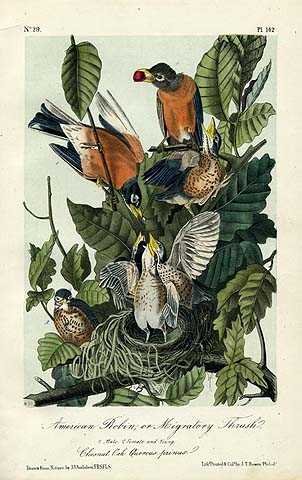
American Robin by Audubon

American Robin by John James Audubon


Audubon's Birds of America

Audubon Biography
by Stephen May

From Bird to Painting to Prints
excerpt from Steiner's "Audubon Art Prints"

The Women in Audubon's Life

Audubon Biography and Prints

Audubon Prints

Audubon Print Primer

Audubon Resources
from minniesland.com

Evaluating Audubon Art

JJ Audubon Gallery

The Double Elephant Cafe
Audubon resources

Natural Wonders, Works by John James Audubon
from the Stark Museum

Audubon Biography
with pictures of his two sons.

American Ornithology
Bird prints by Alexander Wilson, contemporary of Audubon

John Audubon
book and study guide from Cobblestone magazine

John James Audubon
online book by John Burroughs

In the Days of Audubon, A Tale of the "Protector of Birds"
online book by Hezekiah Butterworth


43439: The Boy Who Drew Birds: A Story of John James Audubon The Boy Who Drew Birds: A Story of John James Audubon
By Jacueline Davies / Houghton-mifflin

John James Audubon was a boy who loved the out-of-doors more than the in. He was a boy who believed in studying birds in nature, not just from books. And, in the fall of 1804, he was a boy determined to learn if the small birds nesting near his Pennsylvania home really would return the following spring. This book reveals how the youthful Audubon pioneered a technique essential to our understanding of birds. Capturing the early passion of America's greatest painter of birds, this story will leave young readers listening intently for the call of birds large and small near their own homes. Recommended for ages 5 to 8.


Audubon Word Search


Audubon Crossword Puzzle


Audubon - Word Scramble

Online Crossword Puzzle

Online Word Search


Audubon Study Sheet


Worksheet


Work a Jigsaw Puzzle


From Word Central's Student Dictionary
by Merriam - Webster

(Pronunciation note: the schwa sound is shown by &)


naturalist
Pronunciation: 'nach-(&-)r&-l&st
Function: noun
a person who specializes in natural history

pastel
Pronunciation: pas-'tel
Function: noun
a paste made of powdered pigment ranging from pale to deep colors
and used for making crayons; also : a crayon made of such paste

illegitimate
Pronunciation: il-luh-'ji-t&-m&t
Function: adjective
not recognized as lawful offspring; specifically : born of parents not married to each other

pastel
Pronunciation: pas-'tel
Function: noun
a paste made of powdered pigment ranging from pale to deep colors
and used for making crayons; also : a crayon made of such paste

governess
Pronunciation: 'g&-v&r-n&s
Function: noun
a woman who cares for and supervises a child especially in a private household

ornithology
Pronunciation: "or-n&-'thah-l&-jE
Function: noun
a branch of zoology dealing with birds

octavo
Pronunciation: ahk-'tA-(")vO, -'tä-
Function: noun
the size of a piece of paper cut eight from a sheet;
also : a book, a page, or paper of this size

Alzheimer's disease
Pronunciation: 'ahlts-"hI-m&rz-, 'alts-
Function: noun
Etymology: Alois Alzheimer died 1915 German physician :
a degenerative brain disease of unknown cause that is the most common
form of dementia, that usually starts in late middle age or in old age,
that results in progressive memory loss, impaired thinking, disorientation,
and changes in personality and mood,
and that is marked histologically by the degeneration of brain neurons
especially in the cerebral cortex and by the presence of
neurofibrillary tangles and plaques containing beta-amyloid -- called also Alzheimer's


Biographies in this Series

Presidents of the
United States
George Washington
1st U.S. President

John Adams
2nd U.S. President


Thomas Jefferson
3rd U.S.President


James Monroe
5th U.S. President


Andrew Jackson
7th U.S. President

Abraham Lincoln
16th U.S.President

Franklin D. Roosevelt
32nd U.S. President

John F. Kennedy
35th U.S. President


James Madison
4th U.S. President

Theodore Roosevelt
26th U.S. President

American Patriots Benjamin Franklin
patriot and statesman

Francis Scott Key
Star Spangled Banner

Deborah Sampson
woman soldier
in the Revolutionary War

World Leaders Constantine
Roman Emperor

Alexander the Great
conqueror
Winston Churchill
British Prime Minister

Inventors Alexander Graham Bell
telephone

Johann Gutenberg
printing press

Cyrus McCormick
mechanical reaper

The Wright Brothers
first airplane

Henry Ford
Automaker

Thomas A. Edison
electric light bulb

Sequoyah
Cherokee alphabet

Nikola Tesla
700 patents

.
Explorers Christopher Columbus
explorer

Meriwether Lewis
explorer

Robert Peary
Arctic explorer

John Muir
Naturalist

Matthew Henson
Arctic Explorer

Sir Edmund Hillary
Mr.Everest

Kit Carson
Indian agent

"Johnny Appleseed"
orchardist

.
Women who made
a difference
Clara Barton
founder of the Red Cross

Helen Keller
overcame blindness & deafness

Florence Nightingale
founder of
nursing profession

Joan of Arc
religious and military leader

Amelia Earhart
Aviator

Annie Oakley
sharpshooter

Susan B. Anthony
Suffragette

Elizabeth Keckly
Seamstress

Harriet Tubman
deliverer of slaves

Anne Frank
Diarist

Eleanor Roosevelt
Humanitarian

.
Scientists George Washington Carver
botanist and educator

Sir Isaac Newton
explained gravity and
properties of light

Marie Curie
scientist, physicist

Louis Pasteur
Biologist

Albert Einstein
physicist, genius

Galileo
Astronomer, physicist

Educators Noah Webster
writer of dictionary

Booker T. Washington
leader and educator

Aristotle
Greek philosopher

Physicians Hippocrates
father of medicine

Walter Reed
discovered cause of yellow fever

Albert Schweitzer
humanitarian

Religious Leaders Increase Mather
Salem witch trials

.
Athletes Lou Gehrig
baseball player

Wilma Rudolph
Olympic gold medal winner

Tiger Woods
golfer

Civil Rights
Leaders
Martin Luther King
civil rights leader

Rosa Parks
bus desegregation

Sojourner Truth
Former slave

Frederick Douglass
Abolitionist

Mary Ann Shadd Cary
Civil rights leader

James Forten
Inventor, abolitionist

Composers Beethoven
composer

Artists John James Audubon
artist and naturalist

Gutzon Borglum
sculptor, Mount Rushmore

Ansel Adams
photographer


Home


Back to Famous Leaders