![]() LUDWIG VAN BEETHOVENComposer
|
Ludwig van Beethoven (LOOD vig von BAY toh vun) was one of the world's greatest composers. He wrote many symphonies * , overtures * , and pieces for piano and other instruments.
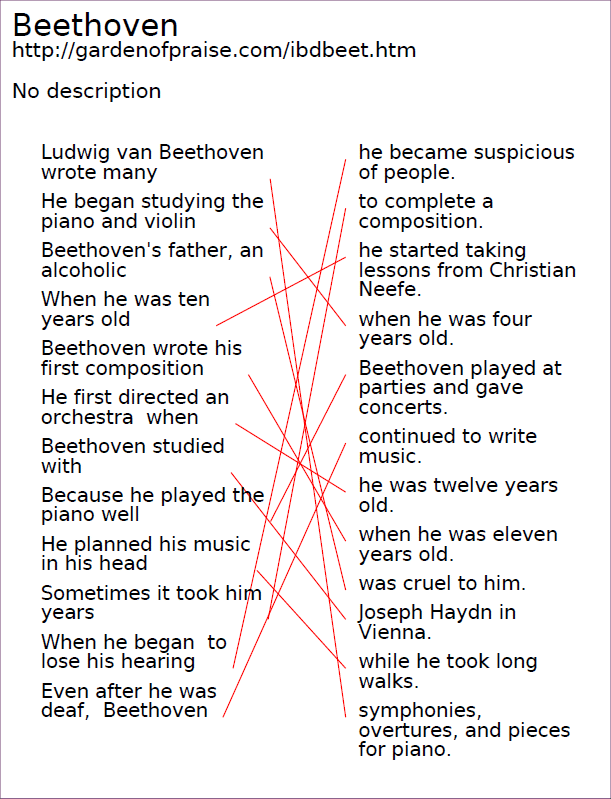
He started studying the piano and violin when he was 4 years old. His father, a singer, was his first teacher. But he was not a good teacher. He beat his son and locked him in a basement to make him practice.
Sometimes when his father came home late after becoming drunk, he would awaken Ludwig and make him practice until morning.
Thirteen-year-old Beethoven |
When he was 10 years old, he started taking
lessons from Christian Neefe. His new teacher was very patient
with him and he began
to do well. He wrote his first composition *
(song) when he was 11.
When he was 12, his teacher let him direct the orchestra part of the time.
|
When he was 22, he moved to Vienna and studied with Joseph Haydn (HI dn). Haydn insisted his student write "pupil of Haydn" at the top of each song he wrote. Beethoven became tired of giving Haydn credit for his songs and quit studying with him.
Most composers at this time were hired by people to write music, and they were told what kind of music to write. Beethoven, however, was treated as a friend, not an employee. He wrote the kind of music he wanted to write.
He knew he could play the piano very well and began to play at parties and to give concerts around Europe. When he needed an orchestra, he used a big orchestra. He would even use some of the instruments in the orchestra to sound like birds in the forest.
He liked taking long walks during the day. During these walks he planned his music. He would make notes in a notebook. Then in the evening after dinner, he would write music from about 7:30 to 10:00 p.m. He followed the same routine every day. If he was dining out and didn't have his notebook with him, he would write on the back of a menu. Once he even wrote on a window shade.
He would work on a composition until it was just right. Sometimes it took years, but it would be perfect when he finished it.
Beethoven began to lose his hearing when he was in his 20's. He became very suspicious * of people and hard to get along with. But he was still able to hear the songs in his mind and write them down.
He did not get along with his two brothers. When his brother Karl died, Beethoven took his 9 year-old son to raise. It was an unhappy time for the child and his uncle. The boy rebelled against him and caused him a lot of grief.
In 1826 he caught a cold. It developed into pneumonia * and he died. The world lost a great composer, but his music lives on today. You will enjoy listening to themes from some of his works.
A frequent question: "Who wrote this biography and when was it written?" Look on this Reference Citations Chart.
![]()
![]()
Ludwig van Beethoven
The Magnificent Master
Ludwig van Beethoven
from World of Biography
Beethoven Symphonies
listen to themes from some of the symphonies at Amazon
Beethoven Piano Sonatas
listen to themes from Beethoven sonatas
Beethoven
pictures and biography
Information about Beethoven
(Look in the box top left) at Humanities Web
Sculptures of Beethoven
from Sculpture Gallery.com
Beethoven
links by William Lane
Biographies of Composers
from Essentials of Music
(click on "Composers" and find Beethoven.)
Beethoven
online book George Alexander Fischer, (View HTML 491KB)
At biography.com search for Beethoven.
Scroll the panel for the "Video & Audio Results".
Beethoven Lives Upstairs - Audiobook on CD
By Classical Kids / Children's Book Store Dist.
In this tale of genius and childhood, an eccentric new boarder turns a young boy's life upside-down. Ludwig Van Beethoven has moved in upstairs! Young Christoph exchanges letters about the chaotic arrival of Mr. Beethoven and learns to appreciate and understand the great composer and his music. The CD features over two dozen excerpts from Beethoven's music including the Moonlight Sonata, Symphonies #5-9, Fur Elise, Pathetique Sonata, Flute Serenade, and Minuet in G Major.
Stories of the Great Composers, Book 1 & CD
By June Montgomery & Maurice Hinson / Alfred Publishing Co., Inc.
Help your elementary students gain a deeper appreciation of music by introducing them to the men and women who created it! Bach to Beethoven, Schubert to Sousa---kids will enjoy reading mini-biographies and stories of 13 composers from the Baroque to Romantic periods. Each chapter highlights important works of a composer; includes question-and-answer activities; and describes the composition on the companion CD. 55 pages, softcover.
Ludwig van Beethoven
By Mike Venezia / Grolier Publishing Company
Author/Illustrator Mike Venezia has been getting to know the world's greatest composers as long as he can remember. A graduate of The School of the Art Institute of Chicago, Mike believes the best way to introduce children to music an composers is through fun. If children can learn about music in a fun way, and think of composers as real people, the exciting world of music will be open to them for the rest of their lives. In this book Venezia briefly recounts the life of Beethoven who wrote beautiful symphonies and sonatas despite tragic personal problems. He illustrates it with a mix of classic pictures and humorous cartoons.
Fandex Field Guide: Composers
By David Bouchier / Workman Publishing
This chronological history of composers and their music offers intriguing facts, anecdotes, and musical insights into composers from Bach, Mozart, and Beethoven to Gershwin and Bernstein. 50 color Fandex cards.
From Word Central's Student Dictionary
by Merriam - Webster
(Pronunciation note: the schwa sound is shown by ə)
symphony
Pronunciation: 'sim(p)-fə-nE
Function: noun
.... a usually long musical composition for a full orchestra....
overture
Pronunciation: 'O-və(r)-"chu(ə)r, -chər
Function: noun
.... a musical composition played by the orchestra as the introduction to an opera or musical play ....
composition
Pronunciation: "kahm-pə-'zish-ən
Function: noun
.... a literary, musical, or artistic production....
suspicious
Pronunciation: sə-'spish-əs
Function: adjective
1 : likely to arouse suspicion : QUESTIONABLE2 : likely to suspect or distrust 3 : showing suspicion
pneumonia
Pronunciation: n(y)u-'mO-nyə
Function: noun
: a disease of the lungs marked by inflammation and congestion and caused by infection or irritants
![]()
Page Comments
Most Recent Comments ( See more comments on this page ) 2009-06-06
I am Siamese, sorry for rusty English.
I am very impressive in Beethoven's symphonies. I think the Beethoven's symphonies were created to simulate a human life cycle. Beginning at his symphony No. 1 = Emerging of a child with innocent feeling of surrounding and got a lot of take care from his parents. Symphony No. 2 = life at teen-age stage with a lot of romantic feeling (I listen the second movement; Oboe-low pitch = male. violin-high pitch = female (sorry, may be mention of wrong instruments. I have no knowledge in music. I listen to music with pure emotional feeling.) and I see the movie "The Sound of Music" at the scene "you are sixteen going on seventeen..."). Also at this stage they possess a lot og impressive feeling in hero (in fact I think the symphony No. 3 represents something like "Tale of a Hero" (first movement = emerging of the hero; second movement = dead of the hero; third movement = celebrate the death hero; fourth movement = legend (I listen the beginning melody of the fourth movement and I feel like "Once upon a time..." or "long long times ago there was...")). The fourth symphony represents life growing up and gaining the knowledge, experience, etc. (the melody reminds me the feeling of the university graduate's atmosphere). To becomes a full strength and intelligent in the fifth. Then it is times to enjoin life at the sixth (Burgundy! Resort!! Royal Salute!!!). The seven symphony represents life going to the old age (first movement = recognizes the fading juvenile (the melody go from low pitch to high pitch); second movement = feeling of deep sorrow (even some crying melody); third movement = try to regain (fitness, exercise, health care, alternative medicine, etc.); fourth movement = achieves some success with feeling of cheer (the melody go from high pitch to low pitch). Eventually life becomes an old man in the eight symphony (first movement = watch the children playing; second movement = teaching, look after the children; third movement = thinking of the passed juvenile life with the feeling of deep sorrow; fourth movement = thinking of the 'would go' place (pantheon, heaven). And THEN! life reaches the ninth symphony = Final Destination!. Then the human world has no chance to listen to the tenth symphony because it was "song of the heaven". (Sorry for very short. I feel much more but diificult to write (in English).
Anon
Leave a Comment View all Comments
Biographies in this Series
Reference citations information for these biographies
Home
Back to Famous Leaders