![]() GEORGE WASHINGTON CARVER
|
George Washington Carver was born in Missouri on the Moses Carver plantation. His parents were slaves. His father died right before George was born, then while he was still a baby, slave traders kidnapped him and his mother. Only George was returned to the plantation.
When he was a baby, he had a disease called whooping cough * . It left him sickly and he couldn't do hard work like the other slaves. His chores were cooking and sewing. He loved to work in the garden.
He taught himself to read. His family was so poor, he couldn't afford to buy a pencil, so he made a holder and used a pencil that was only 1/4 inch long.
He wanted to get an education. When he was 12 years old, he left home to attend a black school. There was only one teacher with 75 children in a small room. While other children played at recess, he studied. He studied at home before and after he did his chores. Soon he knew more than his teacher.
![]()
He wrote to a college to enroll and they accepted him, but when they found out he was black, they told him he couldn't attend.
After five more years, when he was 30 years old, he was accepted at a college in Iowa. He did so well, his teacher helped him to get a transfer * to Iowa State College where he studied
botany * . He learned about plants and farming. He became the best botany student on campus.
He did many things to earn money to pay for his expenses. He sold hominy which he had made, and sometimes he ironed clothes for his classmates. He found an old stove at the city dump and brought it home to cook meals for his friends. He used old wrapping paper for notebooks.
"Don't throw anything away," he would say. "Everything can be used again."
After he graduated, they asked him to teach biology * to the beginning students.
Later he was asked to teach at the Tuskegee Institute in Alabama.
Carver started studying diseases which were attacking the farmers' crops. He also did a lot of experimenting to find new ways to use different plants. He made more than 300 products from peanuts. He even made soap and ink from peanuts. From sweet potatoes, he made 118 products, including flour and candy. He made 75 products from pecans and even made a building material for walls from cotton stalks. He had many good ideas!
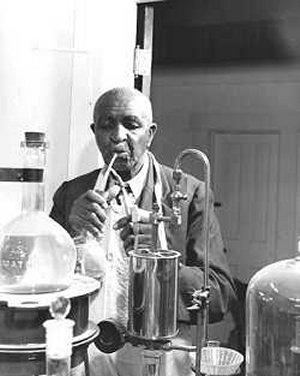
![]()
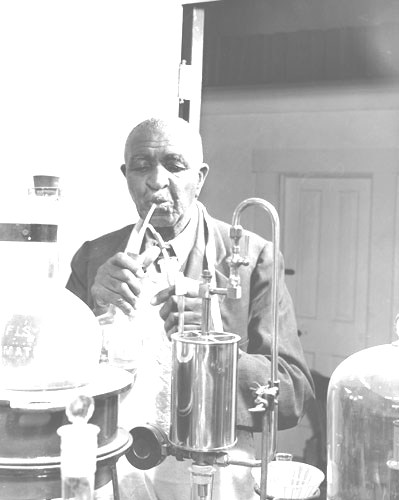
Carver at work in his laboratory
Later in his life, Thomas Edison offered him $100,000 a year to come and work for him, but he thought he could do more good at Tuskegee.
He made his students work hard, and he insisted they do each experiment right. If they told him they had done something "about right", he would say, "Don't tell me it's 'about right'. If it's 'about right', then it's wrong."
Money, stylish clothes, and fine cars were not important to him. He thought the truly successful person was the one who had learned to serve others.
He was one of the finest scientists the world has ever known.
(Some list Carver's birth year as 1864. His exact birthdate is unknown. We have listed it as 1860 because according to a Missouri 1870 census Carver was 10 years old at the time.)
Photo of Carver in his laboratory courtesy of the United States Department of Agriculture
A frequent question: "Who wrote this biography and when was it written?" Look on this Reference Citations Chart.
![]()
![]()
George Washington Carver
picture at American Inventors and Inventions
Legacy of George Washington Carver
Tuskegee University
George Washington Carver National Monument
Lesson Plan - George Washington Carver
The Legacy of George Washington Carver
Iowa State University
Tuskegee Institute
George Washington Carver
products he developed
George Washington Carver National Monument in Diamond, Missouri
pictures at Flickr
George Washington Carver
printable book
George Washington Carver color book
printable book from the USDA.
George Washington Carver
Online book by Rackham Holt
The Sower Series: George Washington Carver: Man's Slave Becomes God's Scientist
By Mott Media, Llc
Born to slave parents, young George was orphaned before he could walk. In his youth he fought poverty and throughout his life he battled prejudice. Yet George Washington Carver emerges as one of history's most remarkable men! How? "The Lord has guided me," Carver was heard often to say. "He has shown me the way, just as He will show everyone who turns to Him." Carver declared, "Without my Savior, I am nothing." With his Savior, the Lord Jesus Christ, George Washington Carver was greatly used by God to discover countless numbers of scientific wonders and to lead a life which has inspired millions of Christians everywhere. For ages 9 to 13.
Heroes of History: George Washington Carver Unit Study Curriculum Guide
By Janet & Geoff Benge / Ywam Publishing
This unit study turns great adventure reading into an even greater learning experience. With historical and thematic depth, this Curriculum Guide provides the schoolteacher and homeschooling parent with countless ways to teach and reinforce diverse curriculum areas as they relate to the life of a key historical figure.Each guide is designed for a wide variety of learning styles, grade levels, and abilities and for both individual and group study. Choose from an array of options to build a meaningful unit study just right for you and your students.
Use with 002833.
Heroes of History: George Washington Carver, From Slave to Scientist
By Janet & Geoff Benge / Ywam Publishing
Once a kidnapped slave baby, George Washington Carver found freedom in learning everything he could about the world around him. Overcoming poverty and racism, George became a brilliant scientist and a gifted professor who dedicated his expertise to helping black farmers escape the devastating grip of poverty. George's scientific creativity knew no limits. His ingenious experimentation with peanuts and other plants helped rescue the failing Southern economy. Still remembered for his reaching and diverse achievements, Dr. Carver generously shared his talent simply for the reward of helping others.
George Washington Carver Biography FunBook
By Carole Marsh & Sherry Moss(Editor) / Gallopade International
Everyone's favorite way to learn about America's bravest citizens! Easy-to-read information, facts, trivia, humor and activities are all included in Biography Funbooks! Discover what inventions of George Washington Carver we still use-and eat-today! Ages 7-12. 14 pages, paperback.
From Word Central's Student Dictionary
by Merriam - Webster
(Pronunciation note: the schwa sound is shown by ə)
whooping cough
Function: noun
: a disease especially of children that is caused by a bacterium and is marked by severe attacks of coughing often followed by a shrill gasping intake of breath -- called also pertussis
transfer
Pronunciation: tran(t)s-'fər, 'tran(t)s-"fər
Function: verb
...: to move to a different place, region, or situation; especially : to withdraw from one school to enroll at another...
botany
Pronunciation: 'baht-ən-e, 'baht-ne
Function: noun
: a branch of biology dealing with plant life...
biology
Pronunciation: bI-'ahl-ə-jE
Function: noun
: a branch of knowledge that deals with living organisms and life processes...
![]()
Page Comments
Most Recent Comments ( See more comments on this page ) 2010-02-05
whoops, I didn't read the end
2010-02-05
He was Born In 1864
Josh2010-01-09
y did u delete the comments
Garden of Praise reserves the right to monitor comments. When feuds and personal attacks on others are posted they will be deleted. Also objectionable language will be eliminated.
Leave a Comment View all Comments
Biographies in this Series
Reference citations information for these biographies
Home
Back to Famous Leaders