MARY ANN SHADD CARY

Civil rights leader
Born in 1823 , died in 1893


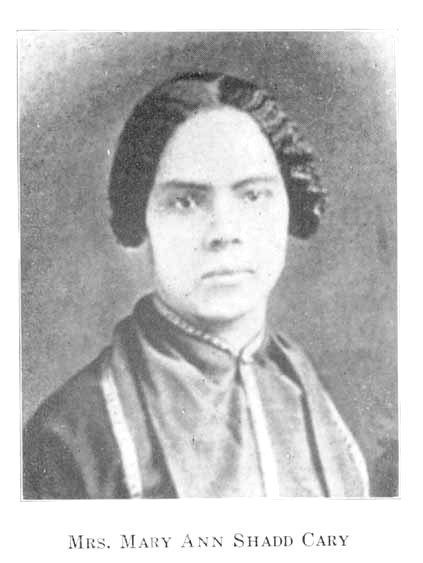
Mary Ann Shadd Cary
 

Mary Ann Shadd was born in Wilmington, Delaware on October 9, 1823. Her father Abraham was a shoemaker. His father, Mary Ann's grandfather, was the son of a free black woman and a German soldier who served under General Braddock in 1755.

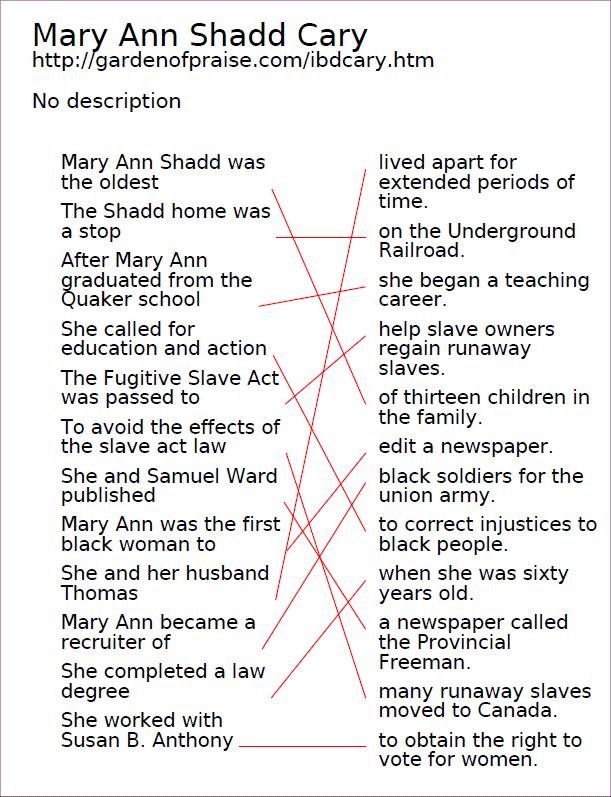
There were thirteen children in Mary Ann's family. She was the oldest. When she was ten years old the family moved to Pennsylvania where she attended a Quaker* school.

The Shadd home was a stop on the Underground Railroad* . They provided shelter for slaves who were running away to find freedom.

Mary Ann was light-colored and being mulatto* was an asset to her family both socially and financially.

After she graduated from the Quaker school she began a teaching career instructing black children.

In 1849 she published an essay called "Hints to the Colored People of the North". She then wrote a letter to Frederick Douglass who published the North Star newspaper. She was critical of the black leaders and the black churches. She called for education and action to correct the injustices which were suffered by blacks.

The passage of the Fugitive* Slave Act in 1850 was to help slave owners regain control of their runaway slaves. Many slaves lived in fear of being returned to their masters and moved to Canada to get beyond the reach of the law.

In 1852 she wrote A Plea for Emigration* or notes on Canada West . Canada had abolished slavery in 1833. Mary Ann took her own advice, moved to Canada, and began to teach there.

In 1854 she teamed up with a minister, Samuel Ward, to publish a newspaper caller the Provincial* Freeman. Her purpose of the paper was to support the fugitive slaves and to urge blacks both slave and free to come to Canada where Mary Ann felt they had greater safety and more opportunities to advance.

She was the first black woman to edit a newspaper. She wrote in one article that she had "broken the editorial ice".

Because Mary Ann's writings were so harsh and abrasive, she made a lot of enemies. She turned the paper over for a while to a minister named William P. Newman. She thought it would prosper better without her leadership.

When she was thirty-two years old she married Thomas Cary of Toronto. He was a barber who owned his own business. He had been married before and had three children. Five days after they married she left on a fund raising trip. She would be away from her husband and children for extended periods of time. She moved to Chatham, Ontario which was 180 miles away. Two years later Thomas moved to be with her.

She and Thomas had two children, Sarah and Linton. Unfortunately, her husband died shortly before Linton was born, and she was left with a 3-year-old, a newborn, and three teen-agers to raise by herself.

She returned to the United States and became a recruiter of black soldiers for the union army.

In 1869, when her youngest child was nine years old, she enrolled in law school at the Washington University. There were 46 students in this first class at the university. In addition to Mary Ann the student body included her 26-year-old brother Abraham. He was twenty years younger than his sister. She went to the university at night and taught school during the day.

Thirteen years later she completed her studies at the age of 60. Some say she practiced law in Washington D.C. for four years. Shamina Sneed of Stanford Law School wrote in her 2002 paper that possibly Mary Ann got the law degree to enhance her image and further herself personally and politically rather than to practice law.

Cary was held in high regard by Frederick Douglass, and she worked with Susan B. Anthony to obtain the right to vote for women.

She died in 1893 after suffering with stomach cancer. Her daughter Sarah was still living. Her son Linton had died the previous year. Her obituary described her as "a woman of excellent traits of character and loved by all who knew her". It goes on to say, "While she may have been excentric* at times, she was a woman of kind disposition."

Her daughter Sarah wrote an essay about her which is published in a book called Homespun* Heroines and Other Women of Distinction.


Some of the facts in this story were taken from a paper called
Mary Ann Shadd Cary - A Biographical Sketch of a Rebel
(See PDF) http://womenslegalhistory.stanford.edu/papers/CaryMAS-Sneed02.pdf
written by Shamina Sneed at Stanford Law School April 5, 2002


Work a Jigsaw Puzzle

Online Crossword Puzzle

Online Word Search

Online Word Scramble

Color Picture Online

PRINTABLES

Mary Ann Cary Word Search

Mary Ann Cary Crossword Puzzle

Mary Ann Cary - Word Scramble

Mary Ann Cary Study Sheet

Worksheet

Color a picture of Mary Ann Cary


Mary Ann Shadd Cary
National Women's Hall of Fame

Timeline Mary Ann Shadd
at Stanford edu

Homespun Heroines and Other Women of Distinction
a a book by Hallie Quinn Brown
(Look for Mrs. Mary Ann Shadd Cary.)

University of Detroit Mercy Black Abolitionist Archive
articles and speeches by Mary Ann Shadd
(Go to "Open File" and when you get to the image, use the "+" to enlarge the print.)

Provincial Freeman
about Shadd's newspaper

Mary Ann Shadd
Black History Pages

Mary Ann Shadd, Pushing the Boundaries
UNESCO.org

Civil War Women
Mary Ann Shadd

Demanding Justice
excerpts from the book at Google books

Mary Ann Shadd Cary,The Black Press and Protest in the Nineteenth Century
by Jane Rhodes at Google Books

Mary Ann Shadd
from SNN student magazine

Mary Ann Shadd House

Breaking the Ice
a film about Mary Ann Shadd

On the Edge of Freedom: Free Black Communities,
Archaeology, and the Underground Railroad
Abstract, doctoral dissertation by Cheryl Janifer LaRoche
presented at University of Maryland 2004
PDF file at https://drum.umd.edu/dspace/bitstream/1903/1676/1/umi-umd-1639.pdf


378430: Primary Sources Teaching Kit: Civil Rights Primary Sources Teaching Kit: Civil Rights
By Karen Baicker / Scholastic Teaching

Students in grades 4-8 can follow the Civil Rights movement from Abraham Lincoln's presidency up to the assassinatin of Martin Luther King Jr. and trace the historical development of this concept through authentic documents, posters, speeches, and true-to-life teaching materials compiled in a user-friendly workbook format. 48 pages include a timeline, and Civil Rights map, glossary and journal.

From Word Central's Student Dictionary
by Merriam - Webster

(Pronunciation note: the schwa sound is shown by &)

Quaker
Pronunciation: kwA-kr
Function: noun
a member of a Christian group that stresses Inner Light,
rejects sacraments and an ordained ministry, and opposes war

mulatto
Pronunciation: m(yoo)-LAT-o
Function: noun
1 : a person with one black and one white parent
2 : a person of mixed white and black descent

Underground Railroad
Function: noun
a system of cooperation in the U.S. before 1863
by which slaves were secretly helped to reach the North or Canada

fugitive
Pronunciation: FYOO-jt-iv
a person who runs away or tries to escape;

provincial
Pronunciation: pr&-VIN-ch&l
of, relating to, or coming from a province

eccentric
Pronunciation: ik-SEN-trik, ek-
Function: adjective
1 acting or thinking in an unusual way such as an eccentric person
2. not of the usual or normal kind as eccentric behavior

homespun
Pronunciation: home-spn
Function: adjective
not worldly : simple as in homespun ideas

emigration
Pronunciation: em-&-GRA-sh&n
Function: noun
leaving a country or region to live elsewhere


Biographies in this Series

Presidents of the
United States
George Washington
1st U.S. President

John Adams
2nd U.S. President


Thomas Jefferson
3rd U.S.President


James Monroe
5th U.S. President


Andrew Jackson
7th U.S. President

Abraham Lincoln
16th U.S.President

Franklin D. Roosevelt
32nd U.S. President

John F. Kennedy
35th U.S. President


James Madison
4th U.S. President

Theodore Roosevelt
26th U.S. President

Ronald Reagan
40th U.S. President

Barack Obama
44th U.S. President-elect

American Patriots Benjamin Franklin
patriot and statesman

Francis Scott Key
Star Spangled Banner

Deborah Sampson
woman soldier in the Revolutionary War

World Leaders Constantine
Roman Emperor

Alexander the Great
conqueror
Winston Churchill
British Prime Minister

Inventors Alexander Graham Bell
telephone

Johann Gutenberg
printing press

Cyrus McCormick
mechanical reaper

The Wright Brothers
first airplane

Henry Ford
Automaker

Thomas A. Edison
electric light bulb

Sequoyah
Cherokee alphabet

Nikola Tesla
700 patents

.
Explorers Christopher Columbus
explorer

Meriwether Lewis
explorer

Robert Peary
Arctic explorer

John Muir
Naturalist

Matthew Henson
Arctic Explorer

Sir Edmund Hillary
Mr.Everest

Kit Carson
Indian agent

"Johnny Appleseed"
orchardist

.
Women who made
a difference
Clara Barton
founder of the Red Cross

Helen Keller
overcame blindness & deafness

Florence Nightingale
founder of nursing profession

Joan of Arc
religious and military leader

Amelia Earhart
Aviator

Annie Oakley
sharpshooter

Susan B. Anthony
Suffragette

Elizabeth Keckly
Seamstress

Harriet Tubman
deliverer of slaves

Anne Frank
Diarist

Eleanor Roosevelt
Humanitarian

.
Scientists George Washington Carver
botanist and educator

Sir Isaac Newton
explained gravity and properties of light

Marie Curie
scientist, physicist

Louis Pasteur
Biologist

Albert Einstein
physicist, genius

Galileo
Astronomer, physicist

Lise Meitner
Physicist

. .
Educators Noah Webster
writer of dictionary

Booker T. Washington
leader and educator

Aristotle
Greek philosopher

Physicians Hippocrates
father of medicine

Walter Reed
discovered cause of yellow fever

Albert Schweitzer
humanitarian

Religious Leaders Increase Mather
Salem witch trials

.
Athletes Lou Gehrig
baseball player

Wilma Rudolph
Olympic gold medal winner

Tiger Woods
golfer

Michael Phelps
Olympic swimmer

. .
Civil Rights
Leaders
Martin Luther King
civil rights leader

Rosa Parks
bus desegregation

Sojourner Truth
Former slave

Frederick Douglass
Abolitionist

Mary Ann Shadd Cary
Civil rights leader

James Forten
Inventor, abolitionist

Gandhi
Indian civil rights leader

César Chávez
Civil rights leader

.
Composers Beethoven
composer

Artists John James Audubon
artist and naturalist

Gutzon Borglum
sculptor, Mount Rushmore

Ansel Adams
photographer


Home


Back to Famous Leaders


Picture courtesy of Wikipedia.

Puzzles on these pages courtesy of
Songs of Praise and Armored Penguin