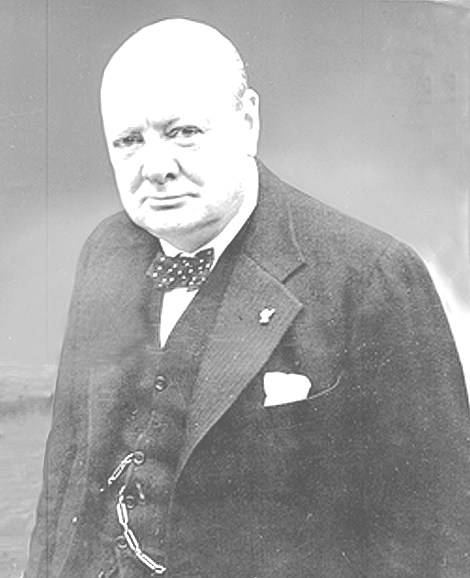
WINSTON CHURCHILL

British Prime Minister
Born in 1874 - Died in 1965


Winston Churchill

Winston Churchill was born in Blenheim Palace in Oxfordshire, England to Lord Randolph Churchill and Lady Jennie Churchill, who was an American.

Winston wrote about his mother in his book "My Early Life". He said she "always seemed like a fairy princess... She shone for me like the Evening Star. I loved her dearly - but at a distance" She was always too busy with her social life to be bothered with her child.

At age eight his parents enrolled him in St. George's, a boarding school at Ascot. He wrote to them that he was happy there, but actually he hated it and did not do well at all. His teachers thought he was "a very naughty boy", and he was frequently punished. He ranked last in his class and was considered lazy.

His headmaster said of him, "He is a constant trouble to everybody and is always in some scrape or other. He cannot be trusted to behave himself anywhere."
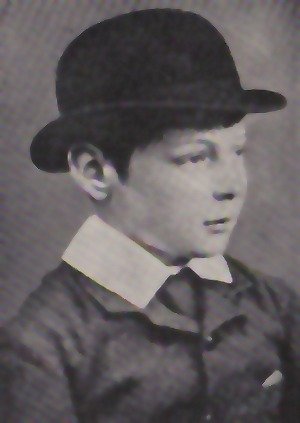

Churchill at School 1884

At age ten his parents removed him from St. George's and he went to a Brighton school run by the Thomson sisters. He was much happier there, but still did poorly in his classes.

He wrote letters to his parents, but they rarely answered them. He visited them at home during the Christmas holidays, and his mother made a trip in February to visit him at his school.

When he was eleven he became very ill with pneumonia. His parents, when they heard the news and thought he might die, finally went to see their son. Otherwise they didn't visit him, even when they happened to be in the same town as the school.

The highlight of his school year was the visit of his nanny, Mrs. Everest, whom he called "Wooms". She had been hired to care for him when he was only a few weeks old and had been his faithful supporter through the years. His younger brother Jack also came with her for the visit.

Winston's parents turned deaf ears to his pleas for them to come to visit him. Many times they would not even answer his letters.

He entered school at Harrow. He still did not do well, but his teachers saw his potential. By age fourteen he was doing very well in history and literature.

One day after looking at the way Winston had his toy soldiers lined up, his father asked him if he would like to go into the Army, and Winston said, "Yes". He felt so good because he thought his father saw him as a military genius. He later learned Lord Randolph thought his son was not intelligent enough to become a lawyer, and the Army was just an alternative.

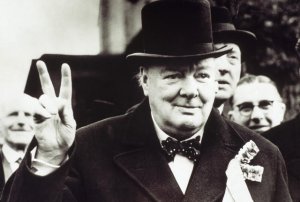
When Winston was fifteen his mother promised him a gun and a pony if he would quit smoking. He quit for a short time. We know when he was an adult he developed a taste for Cuban cigars after a visit to Cuba. The cigar, along with the "V for Victory" hand sign, became his trademark.

The year he turned twenty-one was a difficult year for Winston. His father, Lord Randolph died, and that summer his beloved governess, Mrs. Everest, also passed away. He had spent his whole life trying unsuccessfully to please his father. His faithful governess had always given her unconditional love and support. How ironic!

He joined the Army and during his enlistment he spent time in Cuba, India, and in Egypt. He read a lot, educated himself, and then began writing. He would go to war and when he went home he would write a book about it.

When he was twenty-four he decided to leave the Army and pursue a writing career. He traveled to South Africa as a war correspondent. The Boers derailed the train on which he was riding. After helping those who had been wounded, Churchill was taken captive. He managed to escape by climbing out a latrine window. He made it to Pretoria, South Africa, stowed away on a train, and then was aided in his escape by John Howard, who was the coal mine manager. When he finally arrived home, he learned he had become world-famous overnight. This helped him to launch his political career.

In 1900 the voters elected him to Parliament, an office he would occupy the greater part of his life.

Between World War I and World War II (Two) Churchill began painting and became well-known as an artist.

When he was thirty-four years old he married Clementine Hozier. He later said his most brilliant achievement was persuading his wife to marry him. He said he "lived happily ever afterwards". They had four children; three daughters, Diana, Sarah, and Mary, and one son, Randolph.


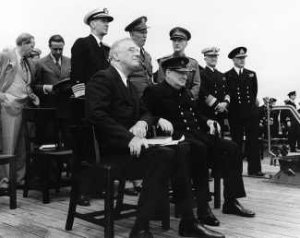
Churchill and FDR 1941

Churchill was one of the few men who recognized the threat Germany posed to the world. He was in a position as lord of the admiralty to build up the British navy. People called him a warmonger, but the fleet was ready when it was needed.

When the Germans invaded Poland on September 1, 1939, it became clear that Churchill's warnings about the threat had been right on target.

On May 10, 1940, when he was sixty-six years old he became prime minister of Great Britain. He said, " I felt as if I were walking with destiny, and that all my past life had been but a preparation for this hour and for this trial".

He declared, " Let us therefore brace ourselves to our duties, and so bear ourselves that if the British Empire and its Commonwealth last for a thousand years, men will say, 'This was their finest hour'".

In 1953 Queen Elizabeth knighted him and he became "Sir Winston Churchill", a member of the highest order of British knighthood.

That same year he also won the Nobel peace prize for literature.

During World War II he had many meetings with Franklin Delano Roosevelt as they mapped out a strategy to win the war against the Axis Powers. Joseph Stalin joined them at Yalta, and they became known as "The Big Three". See FDR Resources.
In 1963 The United States Congress voted to make Winston Churchill an honorary citizen of the United States.

He died two years later at the age of ninety after suffering a stroke.


This biography by Patsy Stevens, a retired teacher, was written in 2007.



A frequent question:
"Who wrote this biography and when was it written?"
Look on this Reference Citations Chart.


Work a Jigsaw Puzzle

Online Crossword Puzzle

Online Word Search

Online Word Scramble

Color Picture Online

Take the Test Online

Online Jeopardy

Online Biography "Who Am I?"

PRINTABLES

Alphabetical Order

Winston Churchill Word Search

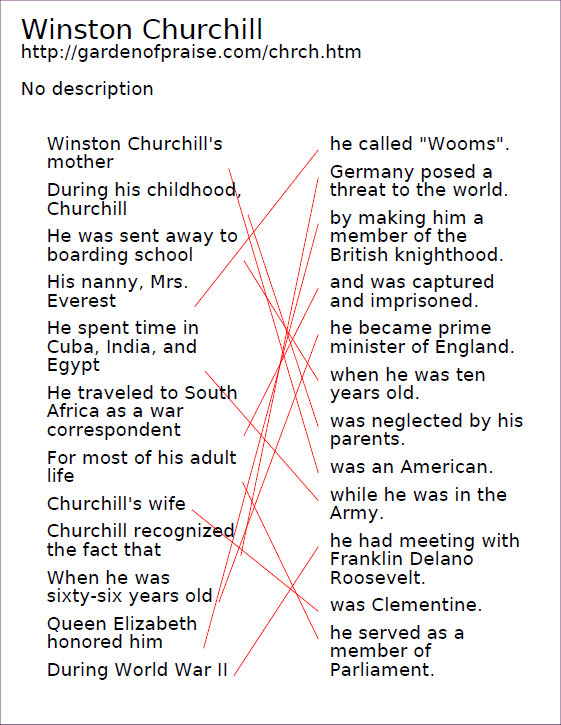
Winston Churchill - Word Match *

Winston Churchill Crossword Puzzle

Winston Churchill - Word Scramble

Winston Churchill Study Sheet

Worksheet

Color a picture of Winston Churchill

Print Winston Churchill Test


RESEARCH LINKS


Winston Churchill
from the Churchill Centre.

Winston Churchill
at BBC

Winston Churchill
from Wikipedia

The Churchill Papers

Winston Churchill
from Spartacus schoolnet.co.uk

"This was their finest hour"
You Tube video

Winston Churchill Quotes

British Prime Ministers
from 10 Downing Street

Winston Churchill, Why We Go to War

Sir Winston Leonard Spencer Churchill
from Answers.com

Winston Churchill Timeline

Winston Churchill Timeline
(See topics in the right-hand column)
School for Champions

School History UK
tests and activities

Winston Churchill
at Buzzle.com

Winston Churchill Obituary

At biography.com search for Winston Churchill.
Scroll the panel for the "Video & Audio Results".


From Word Central's Student Dictionary
by Merriam - Webster

(Pronunciation note: the schwa sound is shown by ə)

governess
Pronunciation: 'gəv-ər-nəs
Function: noun
a woman who teaches and trains a child in a private home

Parliament
Pronunciation: 'pahr-l&-m&nt
Function: noun
a council for discussing government business
the supreme legislative body of various political units
as the British parliament

warmonger
Pronunciation: 'wo(ə)r-"mə[ng]-gər, -"mah[ng]-
Function: noun
one who urges or attempts to stir up war

prime minister
Function: noun
the chief officer of the government in some countries

commonwealth
Function: noun
a political unit (as a nation or state)

knight
Pronunciation: 'nIt
Function: noun
a man honored by a sovereign for merit
and in Great Britain ranking below a baronet

stroke
Function: noun
sudden weakening or loss of consciousness
or the power to feel or move caused by the breaking
or blocking (as by a clot) of a blood vessel in the brain
called also apoplexy

latrine
Pronunciation: lə-'trEn
Function: noun
bathroom, toilet

98537: Winston Churchill: Soldier, Statesman, Artist Winston Churchill: Soldier, Statesman, Artist
By Severance / Houghton-mifflin

Winston Churchill both experienced and influenced the great social and political changes of the first half of the twentieth century. Chruchill was elected to Parliament in 1900; by the time he resigned as Prime Minister of Great Britain, in 1955, he had served under six monarchs and through two world wars. He had changed political parties twice, worked for social reforms, been voted in and out of office, and advocated strong government action to solve problems, even when it was unpopular.

This fascinating chronicle of Churchill's life includes many of his own words - demonstrating the resonance and power with which he used the English language. Churchill's speeches and writings embody the foresight, imagination, and charismatic strength that sustained his countrymen as they fought for their nation's survival. His statesmanship, crucial to England and her allies during both war and peacetime, has had a lasting impact on today's world.

Carefully researched, deftly written, and lavishly illustrated with photographs, Winston Churchill: Soldier Statesman, Artist is a vivid portrait of a unique twentieth-century leader and the dramatic times in which he lived.


553065: Winston Churchill Winston Churchill
By John Perry / Thomas Nelson

Master statesman and orator Winston Churchill was in no small way responsible for the WWII Allied victory over the Axis powers. At many times he stood alone leading the fight against Hitler, absolute in his belief that Britain must "with all the strength that God can give us wage war against a monstrous tyranny." From where did he derive his strength and comfort? In this Christian Encounters biography, discover how Churchill's Anglican faith sustained him during some of the darkest hours in human history.


25779: Wit and Wisdom of Winston Churchill: A Treasury of More Than One Thousand Quotations And... Wit and Wisdom of Winston Churchill: A Treasury of More Than One Thousand Quotations And...
By James Humes / Harpercollins

An enormously entertaining compendium of witticisms, anecdotes, and trivia about Winston Churchill by a former White House speechwriter.

A LIBRARY OF
ONLINE BOOKS and BOOK PREVIEWS

"A Roving Commission", Autobiography of Winston Churchill
by Winston Churchill (public domain, 1930, full view)

Using Biographies in the Classroom
by Garth Sundem, Shell Education , See Sample pages
Order here


Preview these Amazon books using the links below.

Winston Churchill
by Stuart Ball (selected pages)

Clementine Churchill: the biography of a marriage
by Mary Soames (selected pages)

Sir Winston Churchill: His Life and His Paintings
by David Coombs, Minnie Churchill, Minnie S. Churchill (selected pages)

Winston Churchill: British Prime Minister & Statesman
by Sue Vander Hook (selected pages)

Winston Churchill
by Janice Hamilton (selected pages)

Winston Churchill: British Soldier, Writer, Statesman
by Brenda Haugen (selected pages)

Chasing Churchill: The Travels of Winston Churchill
by Celia Sandys (selected pages)


Page Comments

Most Recent Comments   ( See more comments on this page )
2010-09-09
thank you for the help
btm

Leave a Comment       View all Comments


Biographies in this Series

Reference citations information for these biographies


Presidents of
the United States
George Washington John Adams Thomas Jefferson James Madison James Monroe Andrew Jackson
  Martin Van Buren Abraham Lincoln Theodore Roosevelt Franklin D. Roosevelt Harry S. Truman Dwight D. Eisenhower
  John F. Kennedy Lyndon B. Johnson Jimmy Carter Ronald Reagan Barack Obama Calvin Coolidge
American Patriots Benjamin Franklin Francis Scott Key Deborah Sampson Molly Pitcher
World Leaders Constantine Alexander the Great Winston Churchill
Inventors Alexander Graham Bell Johann Gutenberg Cyrus McCormick The Wright Brothers Henry Ford Thomas A. Edison
  Sequoyah Nikola Tesla Michael Faraday Dean Kamen Jack Kilby Leonardo Da Vinci
  Donald O'Neal
Explorers Christopher Columbus Meriwether Lewis Robert Peary John Muir Matthew Henson Sir Edmund Hillary
  Kit Carson Johnny Appleseed Daniel Boone
Women who made
a difference
Clara Barton Helen Keller Florence Nightingale Joan of Arc Amelia Earhart Annie Oakley
  Susan B. Anthony Elizabeth Keckly Harriet Tubman Anne Frank Eleanor Roosevelt Madam C.J. Walker
  Sadako Sasaki Henrietta Lacks        
Scientists George Washington Carver Sir Isaac Newton Marie Curie Louis Pasteur Albert Einstein Galileo
  Lise Meitner Norman Borlaug Benjamin Banneker
Educators Noah Webster Booker T. Washington Aristotle Mary McLeod Bethune
Physicians Hippocrates Walter Reed Albert Schweitzer
Religious Leaders George Muller Increase Mather
Athletes Lou Gehrig Wilma Rudolph Tiger Woods Michael Phelps
Civil Rights
Leaders
Martin Luther King Rosa Parks Sojourner Truth Frederick Douglass Mary Ann Shadd Cary James Forten
  Gandhi César Chávez William Wilberforce Nelson Mandela
Composers Beethoven Mozart
Authors Laura Ingalls Wilder Samuel Clemens (Mark Twain) Ernest Hemingway Greg Mortenson Phillis Wheatley
Artists John James Audubon Gutzon Borglum Ansel Adams Dale Chihuly Van Gogh Michelangelo
  Rembrandt Grandma Moses Cassatt Renoir Cezanne Rockwell

Home


Back to Famous Leaders


Picture courtesy of Wikimedia Commons.

Puzzles on these pages courtesy of
Songs of Praise and Armored Penguin

*Word Match Solution