![]() CONSTANTINERoman Ruler
|
Constantine (KAHN st&n teen) united the Roman Empire * under one ruler. Before this time, it had been divided. When he became emperor * , he made many changes. He wanted people to believe the government would be kind to them. He made a new coin called "solidus" which means solid. This coin was used in the empire for 700 years.
He wanted people to feel safe, and he wanted them to be treated right.
He studied the mistakes of others, and tried not to make the same mistakes.
The ruler made many changes. He said slaves should be treated well, and their families should not be separated. He made Sunday a day of rest.
He was impressed by the Christians' strong faith. He saw they were well organized and loyal. He knew he needed their help. To gain their support, he gave them religious freedom; the freedom to worship as they pleased. He banned * crucifixion * .
He himself became a Christian right before he died.
Constantine believed he had been chosen by God to rule. The capital was named after him. He called it Constantinople
(KAHN stan t& NO pl).
He enjoyed the support of the people. Even though he talked about peace, within his own family there was strife. It is said he even had some members of his family killed.
![]()
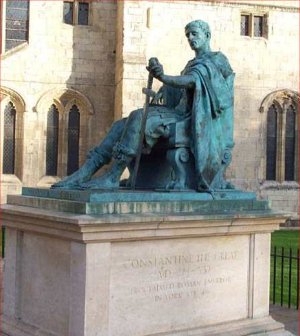
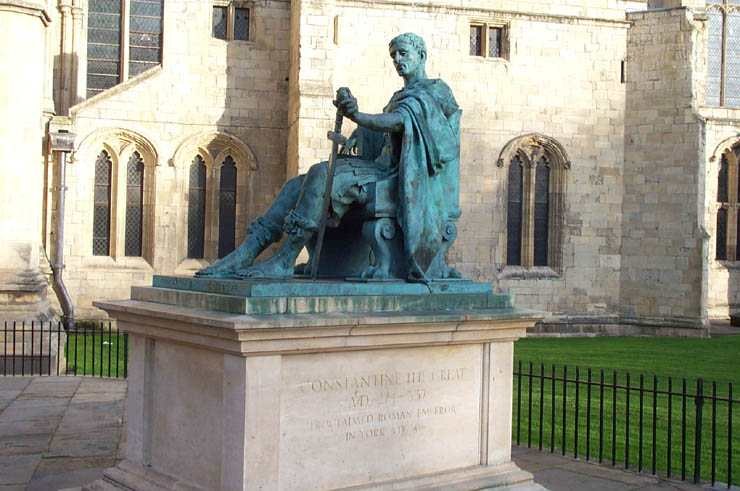
Constantine the Great
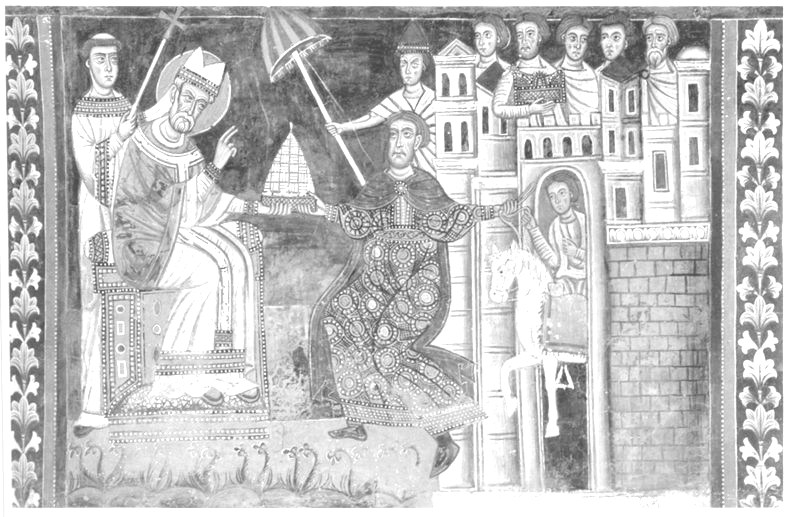
The Emperor Constantine and Jerusalem
Ancient Rome, Thematic Unit
By Teacher Created Resources
Roman Civilization has made important and lasting contributions to the culture of our country and the entire world. Located in the middle of the Mediterranean Sea, Rome conquered and dominated this area and gave it a lasting peace for almost 1000 years. In the process, Roman engineers made the first extensive use of paved roads, the arch and modern plumbing. This unit study covers all areas of the curriculum as it further explores Roman History. The unit includes literature selections, language experience and writing ideas, bulletin board ideas, curriculum connections, a bibliography, group projects and culminating activities. The book used in this unit, that will need to be purchased or borrowed, is "Ancient Rome" by Simon James. There are also many articles in the workbook.
Young Architects Brick and Mortar Construction Kits: Coliseum
By Educational Insights Inc.
Calling all amateur architects!Ages 8+. Experience the fun, excitement, and pride of building ready-to-display stone replicas of world famous architectural masterpieces - brick by brick! Mix the special mortar in the mini-sized wheelbarrow, then follow the step-by-step instructions for building each spectacular structure with real kiln-fired bricks! The special mortar dissolves in water, allowing students to create and build more structures of their own design, and teachers to use the kits year after year!
Each kit includes:
- Hundreds of real-stone bricks
- Bags of special water-soluble mortar mix
- Base with label
- Wheelbarrow for mixing mortar
- Mason's tools
- L-shaped ruler
- 8-page illustrated instruction guide
![]()
Constantine Word Search
Constantine Crossword Puzzle
Constantine - Word Scramble
Online Crossword Puzzle
Online Word Search
Constantine Study Sheet
Worksheet
![]()
Work a Jigsaw Puzzle
From Word Central's Student Dictionary
by Merriam - Webster
(Pronunciation note: the schwa sound is shown by &)
empire
Pronunciation: 'em-"pI(&)r
Function: noun
1 a : a major political unit with a large territory or a number of territories or peoples under one ruler with total authority; especially : one having an emperor as chief of state b : the territory of such a unit ...
emperor
Pronunciation: 'em-p&r-&r, -pr&r
Function: noun
: the ruler of an empire
Word History : The word emperor is a general word for a ruler having total control of a country or region.
Use of the word emperor itself can be traced back to Imperator Caesar Augustus. The Latin word imperator was originally a title given to great Roman generals. The word meant "commander", and it was derived from the verb imperare "to command". It is because Augustus, the first Roman emperor, used imperator as a title that we use emperor as we do today....
banned, ban
Pronunciation: 'ban
Function: verb
: to forbid especially by law or social pressure...
crucifixion, crucify
Pronunciation: 'krü-s&-"fI
Function: verb
: to put to death by nailing or binding the hands and feet to a cross...
Biographies in this Series
Presidents of the
United StatesGeorge Washington
1st U.S. President
John Adams
2nd U.S. President
Thomas Jefferson
3rd U.S.President
James Monroe
5th U.S. President
Andrew Jackson
7th U.S. President
Abraham Lincoln
16th U.S.President
Franklin D. Roosevelt
32nd U.S. President
John F. Kennedy
35th U.S. President
James Madison
4th U.S. President
Theodore Roosevelt
26th U.S. President
American Patriots Benjamin Franklin
patriot and statesman
Francis Scott Key
Star Spangled Banner
Deborah Sampson
woman soldier
in the Revolutionary War
World Leaders Constantine
Roman Emperor
Alexander the Great
conqueror
Winston Churchill
British Prime Minister
Inventors Alexander Graham Bell
telephone
Johann Gutenberg
printing press
Cyrus McCormick
mechanical reaper
The Wright Brothers
first airplane
Henry Ford
Automaker
Thomas A. Edison
electric light bulb
Sequoyah
Cherokee alphabet
Nikola Tesla
700 patents
. Explorers Christopher Columbus
explorer
Meriwether Lewis
explorer
Robert Peary
Arctic explorer
John Muir
Naturalist
Matthew Henson
Arctic Explorer
Sir Edmund Hillary
Mr.Everest
Kit Carson
Indian agent
"Johnny Appleseed"
orchardist
. Women who made
a differenceClara Barton
founder of the Red Cross
Helen Keller
overcame blindness & deafness
Florence Nightingale
founder of
nursing profession
Joan of Arc
religious and military leader
Amelia Earhart
Aviator
Annie Oakley
sharpshooter
Susan B. Anthony
Suffragette
Elizabeth Keckly
Seamstress
Harriet Tubman
deliverer of slaves
Anne Frank
Diarist
Eleanor Roosevelt
Humanitarian
. Scientists George Washington Carver
botanist and educator
Sir Isaac Newton
explained gravity and
properties of light
Marie Curie
scientist, physicist
Louis Pasteur
Biologist
Albert Einstein
physicist, genius
Galileo
Astronomer, physicist
Educators Noah Webster
writer of dictionary
Booker T. Washington
leader and educator
Aristotle
Greek philosopher
Physicians Hippocrates
father of medicine
Walter Reed
discovered cause of yellow fever
Albert Schweitzer
humanitarian
Religious Leaders Increase Mather
Salem witch trials
. Athletes Lou Gehrig
baseball player
Wilma Rudolph
Olympic gold medal winner
Tiger Woods
golfer
Civil Rights
LeadersMartin Luther King
civil rights leader
Rosa Parks
bus desegregation
Sojourner Truth
Former slave
Frederick Douglass
Abolitionist
Mary Ann Shadd Cary
Civil rights leader
James Forten
Inventor, abolitionist
Composers Beethoven
composer
Artists John James Audubon
artist and naturalist
Gutzon Borglum
sculptor, Mount Rushmore
Ansel Adams
photographer
Home
Back to Famous Leaders
![]()
![]()