CYRUS McCORMICK

Born in 1809 - Died in 1884


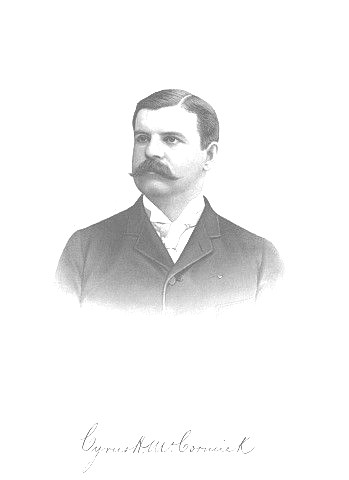
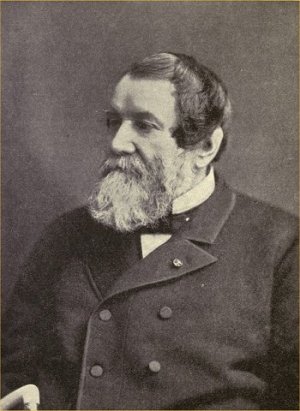
Cyrus McCormick
 

Cyrus McCormick (SIGH rus - mac COR mik) grew up on a farm in Virginia. His goal was to earn a million dollars. In 1833 that was a lot of money. The average worker only earned a nickel an hour. Twenty-six years later, he had earned a million dollars. He had also changed the way people farmed, with his wheat harvester called the reaper. Cyrus and his wife were very generous, sharing their money with people who needed help.

Before his invention, a farmer could harvest only 1/2 acre a day using a scythe * (SIGHTH). With the invention, a farmer and a helper could harvest 12 acres a day!

He had invented the reaper when he was only 22 years old. His father had tried for 15 years to invent a harvester, but had not been able to build one successfully. He had made a lot of mistakes, but young Cyrus learned from his father's mistakes. If a strand of wheat got tangled in the machine, he would get down on his hands and knees to look, until he found out exactly why it had tangled. He asked his father if he could take over working on the invention. His father gave his permission, but thought it was hopeless.


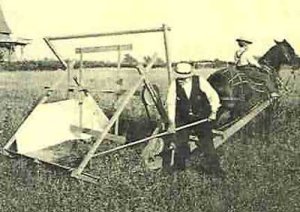
In just 2 months he was able to make a harvester. Some said it looked like a combination of a flying machine, a wheelbarrow, and a carriage * . When he tested it, he could harvest an acre an hour. (Remember, the old by-hand speed was 1/2 acre a day.)

He invited farmers to come and watch him work. They thought it was just entertainment * . They would watch him harvest, and then they would go home and use their old hand scythes. They would say things like, "I'm running a farm, not a circus."

Cyrus decided he would get some of the successful farmers to test his reaper. Maybe they would talk the other farmers into buying a reaper of their own. He just could not interest them, so he decided to work on it some more so it would work even better. He put a blade on it which would chop the wheat off cleanly.

In 1843, another man, who was also making a reaper, challenged him to a contest. They would see who could cut the most wheat. On the day of the contest, it rained. The other man's reaper jammed and wouldn't cut, but McCormick had designed his to cut in damp weather.
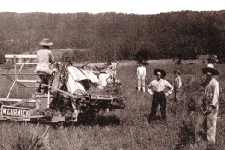
That year he sold 29 reapers and each year after that he sold more and more. By 1850, he was selling 5,000 reapers a year.

His company became the International Harvester Company in 1902.


Grain harvesting history

At the time of his death in 1884, enough grain was shipped from Chicago to bake 10 billion loaves of bread a year, thanks to McCormick's invention.


Work a Jigsaw Puzzle

Online Crossword Puzzle

Online Word Search

Online Word Scramble

Color Picture Online

PRINTABLES

Cyrus McCormick Word Search

Cyrus McCormick Crossword Puzzle

Cyrus McCormick - Word Scramble

Cyrus McCormick Study Sheet

Worksheet

Color a picture of Cyrus McCormick


Cyrus Hall McCormick
National Inventor's Hall of Fame

Mechanical Reaper


Cyrus McCormick's Farm

Online book "Inventors"
Cyrus McCormick, page 207

"Cyrus Hall McCormick - His Life and Work"
online book

Biography of Cyrus McCormick


A Growing National Economy
video lesson
(Click on the topics "Interactive Media Files", be sure volume is turned up.)


22767: Inventions Inventions
By Teacher Created Resources

Thematic Units from Teacher Created Materials are literature based, cross-curricular, and ready to use. They provide activities, many of them hands-on, for all areas of the curriculum, including math, science, language arts, social studies, physical education, art, and music. Each book offers two or more literature-based units and lesson plans plus cross-curricular activities and worksheets, a culminating activity, management ideas, and a bibliography.

Complete and comprehensive, these reproducible units are designed with student interest and teacher usability in mind. The planning is complete. The books used in "Inventions" (that will need to be purchased or borrowed)are: "Steven Caney's Invention Book" by Steven Caney "Ben and Me" by Robert Lawson "Mistakes That Worked" by Charlotte Foltz Jones

Grades 3-5. 80 pages, softcover.


From Word Central's Student Dictionary
by Merriam - Webster

(Pronunciation note: the schwa sound is shown by &)

scythe
Pronunciation: 'sI[th], sI
Function: noun
a tool that has a curved blade on a long curved handle
and is used for mowing grass or grain by hand ...

carriage
Pronunciation: 'kar-ij
Function: noun
a horse-drawn wheeled vehicle designed for carrying persons...

entertainment
Pronunciation: "en-t&r-'tAn-m&nt
Function: noun
a means of amusement or recreation; especially : a public performance...

Biographies in this Series

Presidents of the
United States
George Washington
1st U.S. President

John Adams
2nd U.S. President


Thomas Jefferson
3rd U.S.President


James Monroe
5th U.S. President


Andrew Jackson
7th U.S. President

Abraham Lincoln
16th U.S.President

Franklin D. Roosevelt
32nd U.S. President

John F. Kennedy
35th U.S. President


James Madison
4th U.S. President

Theodore Roosevelt
26th U.S. President

American Patriots Benjamin Franklin
patriot and statesman

Francis Scott Key
Star Spangled Banner

Deborah Sampson
woman soldier in the Revolutionary War

World Leaders Constantine
Roman Emperor

Alexander the Great
conqueror
Winston Churchill
British Prime Minister

Inventors Alexander Graham Bell
telephone

Johann Gutenberg
printing press

Cyrus McCormick
mechanical reaper

The Wright Brothers
first airplane

Henry Ford
Automaker

Thomas A. Edison
electric light bulb

Sequoyah
Cherokee alphabet

Nikola Tesla
700 patents

.
Explorers Christopher Columbus
explorer

Meriwether Lewis
explorer

Robert Peary
Arctic explorer

John Muir
Naturalist

Matthew Henson
Arctic Explorer

Sir Edmund Hillary
Mr.Everest

Kit Carson
Indian agent

"Johnny Appleseed"
orchardist

.
Women who made
a difference
Clara Barton
founder of the Red Cross

Helen Keller
overcame blindness & deafness

Florence Nightingale
founder of nursing profession

Joan of Arc
religious and military leader

Amelia Earhart
Aviator

Annie Oakley
sharpshooter

Susan B. Anthony
Suffragette

Elizabeth Keckly
Seamstress

Harriet Tubman
deliverer of slaves

Anne Frank
Diarist

Eleanor Roosevelt
Humanitarian

.
Scientists George Washington Carver
botanist and educator

Sir Isaac Newton
explained gravity and properties of light

Marie Curie
scientist, physicist

Louis Pasteur
Biologist

Albert Einstein
physicist, genius

Galileo
Astronomer, physicist

Educators Noah Webster
writer of dictionary

Booker T. Washington
leader and educator

Aristotle
Greek philosopher

Physicians Hippocrates
father of medicine

Walter Reed
discovered cause of yellow fever

Albert Schweitzer
humanitarian

Religious Leaders Increase Mather
Salem witch trials

.
Athletes Lou Gehrig
baseball player

Wilma Rudolph
Olympic gold medal winner

Tiger Woods
golfer

Michael Phelps
Olympic swimmer

. .
Civil Rights
Leaders
Martin Luther King
civil rights leader

Rosa Parks
bus desegregation

Sojourner Truth
Former slave

Frederick Douglass
Abolitionist

Mary Ann Shadd Cary
Civil rights leader

James Forten
Inventor, abolitionist

Composers Beethoven
composer

Artists John James Audubon
artist and naturalist

Gutzon Borglum
sculptor, Mount Rushmore

Ansel Adams
photographer


Home


Back to Famous Leaders


Picture courtesy of Corbis.com

Puzzles on these pages courtesy of
Songs of Praise and Armored Penguin