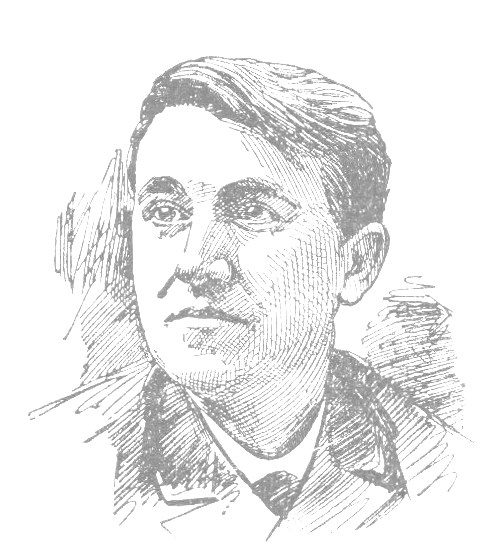
Thomas Edison
Born in 1847 - Died in 1931
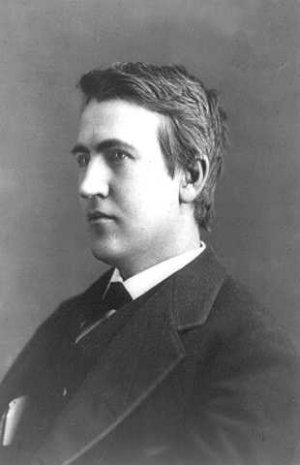
Thomas Alva Edison was called Alva, or Al by his family. He was a very
curious child. He was always asking questions. Even his mother, who
had once been a schoolteacher could not answer all his questions. He
would experiment to try to find the answers. Once he tried to hatch some
eggs by sitting on them. Another time he accidently burned down the
family's barn.
The teacher told someone she thought there was something
wrong with Alva; that he was "addled".
He told his mother and they
took him out of the school. He only went to school for 3 months in
his whole life. Afterwards, he was taught at home.
He wanted to experiment. To make money for his experiments, he went to
work at age 12 selling newspapers and candy on a train. When he had
some spare time on the train, he would do experiments in the baggage car.
When he was 16 he went to work for the telegraph office sending messages.
He became nearly deaf due to an injury to his ears. He later said he
didn't mind being deaf because it helped him to concentrate.
When he was 22 years old he went to New York. He only had $1 in his pocket.
He hunted for a job during the day, and at night he slept in the basement
of a gold company. He watched everything around him very closely.
Some equipment broke down and Edison was able to fix it because he had
been watching it work before he went to sleep each night. The owners
gave him a job. He improved the machine so much the company
paid him $40,000 for his invention. He started the American Telegraph
Works in New Jersey.
He built a laboratory in Menlo Park, New Jersey. It was here with his
employees he made many of his inventions. He would work night after
night, and sometimes he would fall asleep at his workbench. His wife
wouldn't see him for days at a time.
He and his team worked to make a light bulb which would burn for a
long time without burning out. They tried 1,500 materials and nothing
worked well. Finally he tried a new material in the filament that
burned nearly 200 hours.
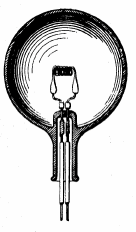
After he had made the light bulb, he worked to make a power system
so people could use the bulb. In 1882 he flipped a switch and
85 houses in New York City had electric lights for the first time.
Thomas Edison was probably the world's greatest inventor. He had a
patent on 1,093 inventions. In addition to the electric light, he also
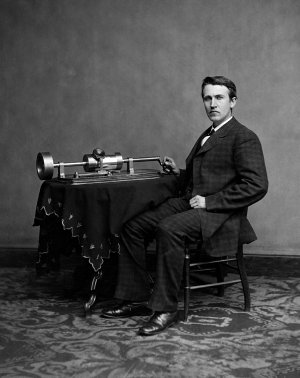
invented the phonograph, a camera to take motion pictures, a cement mixer,
the automatic telegraph, and he improved
Alexander Graham Bell's telephone.
This biography by Patsy Stevens, a retired teacher, was written in 2001.
Activities
Other Activities
Play an Online Game at Quia
Dictionary
From
Word Central's Student Dictionary
by Merriam - Webster
(Pronunciation note: the schwa sound is shown by ə)
addled, addle
Pronunciation: 'ad-əl
Function: verb
Inflected Form: addled
: to make or become confused...
telegraph
Pronunciation: 'tel-ə-'graf
Function: noun
: an electric device or system for sending messages
by a code
over wires ...
phonograph
Pronunciation: 'fO-nə-'graf
Function: noun
: an instrument that reproduces sound recorded on a grooved
disk ...
filament
Pronunciation: 'fil-ə-mənt
Function: noun
: a single thread or a thin flexible threadlike object, process, or
part: as a : a wire (as in a light bulb) that is made to glow by the
passage of an electric current...
automatic
Pronunciation: ot-ə-'mat-ik
Function: adjective
: having devices or mechanisms (as timers) that permit
operation without help from a person, (automatic washer)...
Research Links
Edison's Miracle of Light PBS site
Thomas Edison Birthplace Museum
Thomas Edison.com
Edison Inventsfrom the Smithsonian
Early Motion Pictures
Edison After Fortyfrom American History
Thomas Alva Edison
A Day With Thomas A. Edison at PBS
Thomas Edison at the Library of Congress
Thomas A. Edison PapersRutgers
Thomas Edison Timeline(See topics in the right-hand column)
School for Champions
Famous Americans Coloring Pages
More Inventorsfrom Enchanted Learning
Incandescent Light Bulbhistory of the light bulb
Questions and Answers about EdisonNational Park Service
Thomas Edison versus Nikola TeslaWho is more productive?
Arc Lights (audio)
The Vacuum Tube (audio)
Edison's Big Failure (audio)
Edison's Golden Years (audio)
Engines of Our Ingenuity.
At biography.com search for Thomas Edison.
Scroll the panel for the "Video & Audio Results".
Videos
Books
Press "Go" to search for books about Thomas Edison
Library
A LIBRARY OF
ONLINE BOOKS and BOOK PREVIEWS
Order the following books from Amazon.
Thomas Edison for kids: his life and ideas : 21 activitiesby Laurie Carlson (selected pages) Order
here )
A Picture Book of Thomas Edisonby Alexandra Wallner (selected pages) Order
here
Thomas Edison, First Biographiesby Lola M. Schaefer (selected pages) Order
here
Thomas Edison, Trailblazer of the Modern Worldby Richard Hantula (selected pages) Order
here
Thomas Edison: the wizard inventorby Haydn Middleton (review, but no page views) Order
here
Thomas Edison: The Man Who Lit Up the Worldby Martin Woodside (selected pages) Order
here
Thomas Edison, Kids Can Read Level 3by Elizabeth MacLeod, Andrej Krystoforski (selected pages) Order
here
Thomas Edison (Essential Lives)by Charles E. Pederson (selected pages) Order
here
Thomas Edisonby Rebecca Gomez (selected pages) Order
here
Thomas Edison: And the Developers of Electromagnetismby Elizabeth R. Cregan (selected pages) Order
here
Young Thomas Edisonby Sterling North (selected pages) Order
here
Thomas Edison and the Light Bulb (Weekly Reader)by Monica L. Rausch (selected pages) Order
here
Thomas Edison and the Lightbulb (Graphic Library)by Scott R. Welvaert (selected pages) Order
here
From Telegraph to Light Bulb with Thomas Edisonby Deborah Hedstrom-Page, Deborah Hedstrom, Sergio Martinez (selected pages) Order
here
Lightby Rebecca Olien (selected pages) Order
here
Thomas Edisonby Carole Marsh (selected pages) Order
here
Thomas A. Edison: An Inspiring Story for Boyswritten in 1931 by Francis Trevelyan Miller (selected pages) Order
here
Thomas Edison Invents the Light Bulb (Reader's Theater)by Susan Shafer (selected pages) Order
here
Using Biographies in the Classroomby Garth Sundem, Shell Education,
See Sample pagesOrder
here
Great Scientists and Discoveriesby Ron Shaw (selected pages) Order
here
The Picture History of Great Inventorsby Gillian Clements (selected pages) Order
here
Thomas Edison, Compass Point Booksby Lucia Raatma (selected pages)
Thomas Edisonby Shannon Zemlicka, Shannon Knudsen (selected pages)
Thomas Edison, Photo Illustrated Biographiesby Greg Linder (selected pages)
Thomas Edison, Inventor, Scientist, and Geniusby Lori Mortensen, Jeffrey Thompson (selected pages)
Thomas Edison, Inventor of the Age of Electricityby Linda Tagliaferro (selected pages)
Thomas Edison, Young Inventorby Sue Guthridge (selected pages)
Young Thomas Edisonby Michael Dooling (selected pages)
Credits and Solutions
Picture courtesy of
Wikimedia Commons.
Puzzles on these pages courtesy of
Songs of Praise and
Armored Penguin
* Word Match Solution
Light bulb courtesy
Wikipedia
This page displayed 518,867 times.
This is a mobile page of
Garden of Praise. You are using a desktop computer. Try viewing the
mobile pages on your smart phone.






 A frequent question: