![]() ELEANOR ROOSEVELT
|
Eleanor Roosevelt (ROHZ uh velt) was born October 11, 1884 into a wealthy New York family. She was not a pretty child, in fact she was quite homely *, and her mother seemed to be disappointed because she had hoped for an attractive daughter. Hurtful comments were made in front of Eleanor.
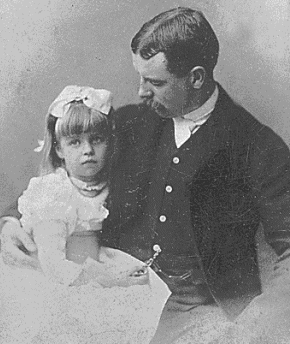
Eleanor with her father Elliot
Larger viewHer father, Elliot however adored his child. He made her feel loved. There was just one problem; he was an alcoholic and was a constant disappointment to her. He would make promises to her and not fulfill them. Sometimes he would leave her waiting outside a bar while he went in and became drunk.
Her mother died of diphtheria * when Eleanor was eight years old, but her father was in a mental institution because of his addictions, so Eleanor and her brothers went to live with Grandmother Hall, their maternal* grandmother. She was very strict with the children, but she loved them. Her father would die two years later.When she was 15 her grandmother enrolled her in a boarding school called Allenswood which was near London. She blossomed at the school. The emphasis at the school was on intellect and what a person was like inside rather than on outward appearances. For the first time in her life she found a place of acceptance and belonging.
She returned to New York at age 18 and there she met a distant cousin, Franklin Roosevelt. He was impressed with the good works she was doing in the slums among the poor immigrants of the city. They became engaged and married in 1905. They started a family. Anna was born first, then James the next year. Franklin Jr. only lived seven months. Next came Elliot, then another son they named Franklin Jr., and John was their last son.
![]()
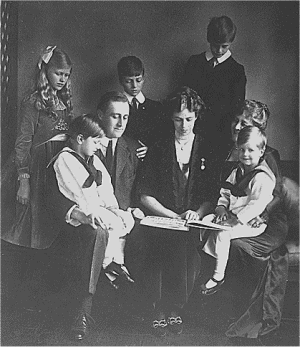
Eleanor and Franklin
with Anna and James
Larger view
Family portrait including
mother-in-law Sara Roosevelt
Larger viewSara Roosevelt, Eleanor's mother-in-law was always "in the picture". She tried to run their lives. When they married she bought a townhouse for them ... and also furnished it. She bought the house right next to theirs for herself and had connecting doors installed. The family had no privacy. She competed with Eleanor for the love of the children. It was not a happy situation, and her marriage with Franklin was turbulent *.
Her husband Franklin Delano Roosevelt became a lawyer, then a senator, and next the Assistant Secretary of the Navy. Eleanor decided she had to make something of her life apart from her husband. She was an organizer and a fund raiser.
Tragedy struck the family. Franklin became ill with the dreaded disease polio *. He became paralyzed and could not walk. He went to live in Warm Springs, Georgia to receive treatment for the effects of the polio.
Louis Howe encouraged Eleanor and helped her. She was adept* at organizing women. She enlisted the press to help further her causes. She became a powerful force in the Democratic Party. She became a teacher three days a week. She and the children moved into a home of her own; Val Kill Cottage in Hyde Park.
Her husband campaigned for governor of New York and won. She was now the governor's wife. Then he ran for President in 1932 and won that office also. His slogan was "Happy days are here again".
As First Lady she now had even more influence even though she didn't cherish the role. She urged FDR to appoint women to positions in the government. She traveled extensively. In a three month period she traveled 40,000 miles.
From 1935 to 1962 she wrote a syndicated * newspaper column six days a week which appeared in many newspapers. It was called My Day.
She worked tirelessly for the advancement of African Americans in America.
In 1958 the Ku Klux Klan put a bounty of $25,000 on her head because they didn't want her teaching people how to protest discrimination.
"We can't afford to have two kinds of citizens, We must have equal citizenship for anybody in our country." Eleanor Roosevelt
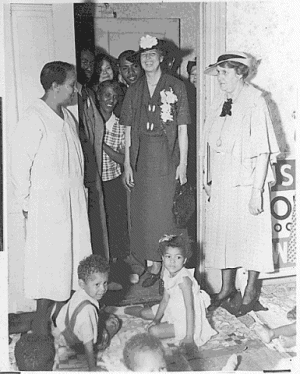
Eleanor visits a
WPA nursery school in Iowa
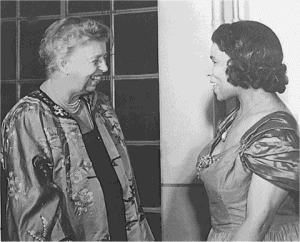
Larger viewIn 1936 her husband ran for a second term as President and won by a landslide *. In 1939 the Daughters of the American Revolution (DAR) refused to let Marian Anderson perform in Constitution Hall in Washington D.C. because of her race. Mrs. Roosevelt resigned her membership in the DAR as a result of the prejudice shown to Marian, and she arranged for the singer to give a performance at the Lincoln Memorial. There were 75,000 people in attendance.
World War 2 started during Roosevelt's third term in office. Eleanor visited the troops and went to the hospitals to encourage the wounded. The soldiers loved her. Her husband was elected to a fourth term as President in 1944. However, his health was declining and he died in April of the following year. Eleanor moved back to her house.
![]()
Awarding a Purple Heart
in New Caledonia
Larger view
![]()
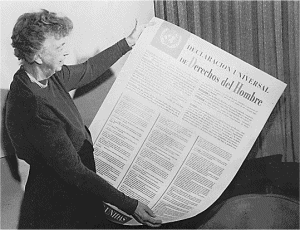
UN Declaration of Human Rights in Spanish
Larger viewHarry Truman, who was the next President, asked her to be a delegate to the United Nations in London. She was instrumental in the creation of the Human Rights Declaration. She continued to work for human rights the remainder of her life. Her accomplishments were amazing during her latter years. She is one of the most admired women in American history.
Eleanor Roosevelt died of bone marrow tuberculosis * on November 7, 1962. She was 78 years old.
![]()
The American Experience: Eleanor Roosevelt
transcript of PBS program (Students may want to increase the text size.)
Eleanor Roosevelt
Timeline at PBS
Eleanor Roosevelt Timeline
at George Washington University
Eleanor Roosevelt Timeline
at MSNBC News
Eleanor Roosevelt Biography - A Public Life
Dear Mrs. Roosevelt
letters written to her during the Depression
Eleanor Roosevelt Center at Val-Kill
Eleanor Roosevelt and Human Rights
Eleanor Roosevelt
The Time 100
The Wallflower That Blossomed
Eleanor Roosevelt
at Wikipedia
At biography.com search for Eleanor Roosevelt.
Scroll the panel for the "Video & Audio Results".
Eleanor Roosevelt: A Life of Discovery, Hardcover
By Freedman / Houghton-mifflin
Widely recognized as the most influential woman of her time, Eleanor Roosevelt began life as by her own account and "ugly duckling," the timid and lonely child of unhappy parents. She was serious and reserved, not beautiful and bubbly like other society women. She was expected to devote herself strictly to the traditional roles of wife and mother, and to her husband Franklin's political career.As First Lady, she went beyond the long-established position of White House hostess to act as FDR's eyes and ears, traveling extensively to gather information and represent her husband in places he, wheelchair-bound, could not go. Mrs. Roosevelt became a passionate advocate for the weak an disadvantaged in American society.
After her husband's death in 1945, she continued her activities on a global scale, serving as an American delegate to the United Nations, where her work on behalf of human rights earned her the title "First Lady of the World." Recommended for ages 8 to 12. A 1994 Newbery Honor book.
![]()
Eleanor Roosevelt Word Search
Eleanor Roosevelt Crossword Puzzle
Eleanor Roosevelt - Word Scramble
Online Crossword Puzzle
Online Word Search
Eleanor Roosevelt Study Sheet
Worksheet
![]()
Work a Jigsaw Puzzle
From Word Central's Student Dictionary
by Merriam - Webster
maternal
muh TERN uhl
Function: adjective
related through a mother as maternal grandparents
turbulent
TURB yoo lunt
Function: adjective
characterized by agitation or tumult
adept
uh DEPT
Function: adjective
thoroughly proficient : expert
syndicate
SIN duh kAt
Function: verb
to sell (as an article) to a syndicate or for publication in many newspapers or periodicals at once
homely
HOME le
Function: adjective
not pretty or handsome as a homely person
diphtheria
dif THIR e uh
Function: noun
a contagious bacterial disease with fever in which the air passages
become coated with a membranous layer that often obstructs breathing
poliomyelitis
PO le OH MY uh lite us
Function: noun
an infectious virus disease marked by inflammation of nerve cells
in the spinal cord accompanied by fever and often paralysis
and wasting of muscles -- called also infantile paralysis
landslide
LAND slId
Function: noun
an overwhelming victory especially in a political contest as in he won by a landslide
tuberculosis
t(y)oo bur kyoo LO sus
Function: noun
a disease of human beings and some other vertebrates caused by a bacterium
and usually marked by wasting, fever, and formation of
cheesy tubercles that in human beings occur mostly in the lungs
Biographies in this Series
Presidents of the
United StatesGeorge Washington
1st U.S. President
John Adams
2nd U.S. President
Thomas Jefferson
3rd U.S.President
James Monroe
5th U.S. President
Andrew Jackson
7th U.S. President
Abraham Lincoln
16th U.S.President
Franklin D. Roosevelt
32nd U.S. President
John F. Kennedy
35th U.S. President
James Madison
4th U.S. President
Theodore Roosevelt
26th U.S. President
American Patriots Benjamin Franklin
patriot and statesman
Francis Scott Key
Star Spangled Banner
Deborah Sampson
woman soldier
in the Revolutionary War
World Leaders Constantine
Roman Emperor
Alexander the Great
conqueror
Winston Churchill
British Prime Minister
Inventors Alexander Graham Bell
telephone
Johann Gutenberg
printing press
Cyrus McCormick
mechanical reaper
The Wright Brothers
first airplane
Henry Ford
Automaker
Thomas A. Edison
electric light bulb
Sequoyah
Cherokee alphabet
Nikola Tesla
700 patents
. Explorers Christopher Columbus
explorer
Meriwether Lewis
explorer
Robert Peary
Arctic explorer
John Muir
Naturalist
Matthew Henson
Arctic Explorer
Sir Edmund Hillary
Mr.Everest
Kit Carson
Indian agent
"Johnny Appleseed"
orchardist
. Women who made
a differenceClara Barton
founder of the Red Cross
Helen Keller
overcame blindness & deafness
Florence Nightingale
founder of
nursing profession
Joan of Arc
religious and military leader
Amelia Earhart
Aviator
Annie Oakley
sharpshooter
Susan B. Anthony
Suffragette
Elizabeth Keckly
Seamstress
Harriet Tubman
deliverer of slaves
Anne Frank
Diarist
Eleanor Roosevelt
Humanitarian
. Scientists George Washington Carver
botanist and educator
Sir Isaac Newton
explained gravity and
properties of light
Marie Curie
scientist, physicist
Louis Pasteur
Biologist
Albert Einstein
physicist, genius
Galileo
Astronomer, physicist
Educators Noah Webster
writer of dictionary
Booker T. Washington
leader and educator
Aristotle
Greek philosopher
Physicians Hippocrates
father of medicine
Walter Reed
discovered cause of yellow fever
Albert Schweitzer
humanitarian
Religious Leaders Increase Mather
Salem witch trials
. Athletes Lou Gehrig
baseball player
Wilma Rudolph
Olympic gold medal winner
Tiger Woods
golfer
Civil Rights
LeadersMartin Luther King
civil rights leader
Rosa Parks
bus desegregation
Sojourner Truth
Former slave
Frederick Douglass
Abolitionist
Mary Ann Shadd Cary
Civil rights leader
James Forten
Inventor, abolitionist
Composers Beethoven
composer
Artists John James Audubon
artist and naturalist
Gutzon Borglum
sculptor, Mount Rushmore
Ansel Adams
photographer
Home
Back to Famous Leaders
![]()
Puzzles courtesy of Armored Penguin
Photos courtesy Franklin D. Roosevelt Presidential Library and Museum public domain pictures,