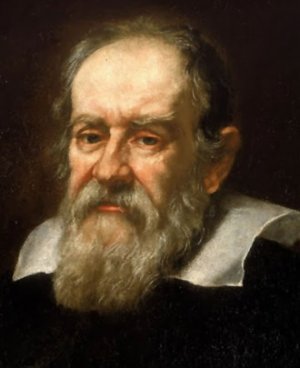
GALILEO GALILEI

Astronomer, Physicist
1564 - 1642


Galileo

Galileo Galilei ( gal ih LAY oh gal ih LAY ee) was born in Pisa, Italy on February 15, 1564. His father, Vencenzio, was a musician and a mathematician. He was Galileo's teacher until he was ten years old. At that time the family moved to Florence. The boy was tutored for a while and then attended a monastery* where he studied Latin, Greek, logic, music, and religion.

The Lamp of Galileo

While he was a student at the University of Pisa he began to study the pendulum by watching a suspended lamp swing back and forth in the cathedral. From these first observations came his theory for the pendulum clock. Near the end of his life he would design the first pendulum clock.

Galileo is called the Father of Modern Science. He was the first to develop a scientific theory in which he would observe an event, develop a theory and then experiment to test his theory.

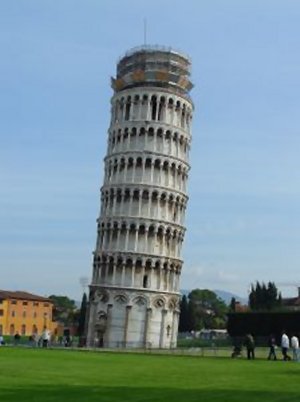
He studied motion and performed experiments by dropping objects from heights such as the Leaning Tower of Pisa. He wanted to disprove Aristotle's idea that heavier objects fall faster than lighter ones. According to legend he dropped two objects of different weights and proved that two falling objects of different weights reach the ground at the same time. You can view a photograph of a falling objects demonstration.
In this video astronaut David Scott demonstrates Galileo's theory of falling objects by showing how they behave in a weightless environment.

Before Galileo's time many people believed the earth was the center of the universe and the sun and the planets moved in an orbit around the earth. This theory was described by a Roman astronomer named Ptolemy (TAH luh me) and was called the Ptolemaic (tah luh MA ik) Theory. Aristotle also believed the sun moved around the earth. To believe otherwise was considered heresy by the Roman Catholic Church, and people were persecuted who believed the earth was not central.

Nicolaus Copernicus (nik uh LA us ko PUR nih kus) about twenty years before Galileo was born published a theory that the earth revolved around the sun. It was called the Copernican (ko PER nih kuhn) Theory, but he died before he could prove it.

Galileo decided he would either prove Copernicus' theory or else show it was false. In 1609 he heard about an invention which enabled people to see things far away. It was the telescope . He reproduced it and studied the moon and the planets. He discovered four bright "stars" revolving around Jupiter and concluded they must be planets near Jupiter. He called them Medician (med uh CHEE un) Stars to honor his patron in the influential Medici (MED ih chee) family. These moons of Jupiter are now named Io, Europa, Ganymede, and Callisto. Shortly after his discovery he was appointed Chief Mathematician of the University of Pisa. He would hold the title for life.

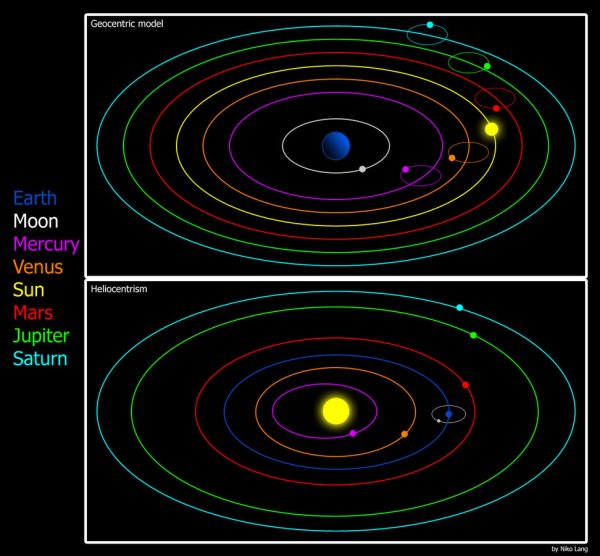
Galileo concluded that if "planets", as he called them, could revolve around another planet, then the planets could also revolve around another body such as the sun. His view of the cosmos* is known as heliocentrism * . This model is shown at the bottom of the illustration with the sun in the center. The upper part of the illustration shows a geocentric * model with the earth at the center.

Larger View

Galileo went to Rome and appeared before the Roman Church to defend his views, but the Church considered them heresy* since his ideas were contrary to the Ptolemaic view that the sun revolved around the earth, which they considered the Biblical view. He was forbidden to discuss or write about his theory.

When a new pope was appointed Galileo had new hope that he would be heard. In April 1624 he traveled to Rome and had six audiences with Pope Urban VIII. As a result of his visit he was permitted to discuss his theory as long as he treated it as a mathematical hypothesis* .

However, after the printing of Galileo's book Dialogue* he was summoned to appear before the Inquisition* . Galileo replied that he was too ill to go to Rome. He was told he would be arrested and brought in chains if he did not come. He went to Rome where he was questioned for 18 days.

At an Inquisition the accused person had to testify, but could not ask questions nor be represented by counsel. Sometimes a person was tortured to get them to "confess", and the sentence could not be appealed.

They condemned him for heresy and put him under house arrest. He was released for a while, but there would be further hearings and he would remain under arrest the remainder of his life. Five years after his sentencing he became totally blind. He asked to be released from his imprisonment, but his plea was denied.

During his lifetime Galileo had three children; two girls and a boy. His girls were Virginia and Livia who were both raised in convents and his son, Vencenzio, was named after his grandfather, Galileo's father.

Galileo respected people. He is quoted as saying "he never met a man so ignorant but that something might be learnt from him." He did not have unkind words even for those with whom he totally disagreed.

Galileo died on January 8, 1642 while still under house arrest at his home in Arcetri near Florence.


A frequent question: "Who wrote this biography and when was it written?" Look on this Reference Citations Chart.


Work a Jigsaw Puzzle

Online Crossword Puzzle

Online Word Search

Online Word Scramble

Color Picture Online

Take the Test Online

Online Jeopardy

Online Biography "Who Am I?"

PRINTABLES

Galileo Word Search

Galileo Crossword Puzzle


Galileo - Word Scramble


Galileo Study Sheet


Worksheet


Color a picture of Galileo


Print Galileo Test


Print Excerpts from "The Private Life of Galileo"


The Galileo Project
Rice University

Galileo
easy biography at Hero History

Galileo Galilei
Institute and Museum of the History of Science

Galileo Biography
article by J.J. O'Connor and E.F. Robertson

Galileo
at Wikipedia

Galileo Galilei
Catholic Encyclopedia edu

Galileo's Observations of the Moon

Galileo Galilei
The Internet Encyclopedia of Science BBC

Galileo Galilei
biography

The Discovery of the Galilean Satellites (NASA)

Galileo: the Telescope & the Laws of Dynamics
Linda Hall Library

Student Projects and Experiments
Rice University

Pendulum Simulation
my physics lab

What's a Pendulum Anyway?
California Academy of Sciences

The Private Life of Galileo
online book

The Sidereal Messenger (English Version) by Galileo
Linda Hall Library


78139X: Galileo DVD Genius Series Galileo DVD Genius Series
By Kultur International Films

This is the story of the brilliant Italian astronomer and mathematician who dared to challenge the accepted teachings of his day. Galileo's work brought him to the attention of the Inquisition and one of history's greatest minds was forced to work his last years under house arrest. Featuring specially-filmed dramatized depictions and rare contemporary images, this program vividly recreates Galileo's life and work. It also includes expert commentary and analyses by eminent historians.

This DVD features:

  • Exact Mathematical Measurement
  • Gravity and Flotation
  • The Principle of Inertia
  • The Telescope
  • Controversy with the Church
  • Motion and Acceleration
Running time: 50 minutes.

109917: Galileo Galileo
By Paul Mason / Heinemann Raintree School
Galileo was one of the greatest scientists of all time, yet was persecuted dearly for his scientific discoveries. The inventor of the thermometer and spyglass, he would be remembered primarily for proving Copernicus' theory that the earth revolves around the sun. This colorful book is full of historic paintings, photographs of places, and intriguing sidebars offering insights into Galileo's discoveries. The Groundbreakers Series examines the experiences that inspired amazing individuals to think in new ways, and what in their environment affected their work. 48 pages, indexed, softcover.


From Word Central's Student Dictionary
by Merriam - Webster

(Pronunciation note: the schwa sound is shown by ə)

monastery
MAHN uh ster e
Function: noun
a place where a community of monks or nuns live and work

cosmos
KAHZ mus or KAHZ mohs
Function: noun
1 : the orderly universe
2 : a complex harmonious system

heliocentric
he le oh SEN trik
Function: adjective
1 : referred to or measured from the sun's center or appearing as if seen from it
2 : having or relating to the sun as a center

heresy
HEHR uh se
Function: noun
1 : religious opinion that is opposed to the doctrines of a church
2 : opinion that is opposed to a generally accepted belief

hypothesis
hi PAHTH uh sus
Function: noun
something not proved but assumed to be true for purposes of
argument or further study or investigation

dialogue
DI uh log
Function: noun
1 : a conversation between two or more persons
2 : conversation given in a written story or play

Inquisition
in kwuh ZISH uhn
Function: noun
capitalized : a. former Roman Catholic court for the discovery and punishment of heresy
b. : an investigation conducted with little concern for individual rights
c. : a severe questioning

geocentric
je oh SEN trik
Function: adjective
1 : relating to or measured from the earth's center
2 : having or relating to the earth as a center


Page Comments

Most Recent Comments   ( See more comments on this page )
2009-08-06
the story was really interesting and has a lot of facts.

Leave a Comment       View all Comments


Biographies in this Series

Reference citations information for these biographies


Presidents of
the United States
George Washington John Adams Thomas Jefferson James Madison James Monroe Andrew Jackson
  Abraham Lincoln Theodore Roosevelt Franklin D. Roosevelt John F. Kennedy Ronald Reagan Barack Obama
American Patriots Benjamin Franklin Francis Scott Key Deborah Sampson
World Leaders Constantine Alexander the Great Winston Churchill
Inventors Alexander Graham Bell Johann Gutenberg Cyrus McCormick The Wright Brothers Henry Ford Thomas A. Edison
  Sequoyah Nikola Tesla
Explorers Christopher Columbus Meriwether Lewis Robert Peary John Muir Matthew Henson Sir Edmund Hillary
  Kit Carson "Johnny Appleseed"
Women who made
a difference
Clara Barton Helen Keller Florence Nightingale Joan of Arc Amelia Earhart Annie Oakley
  Susan B. Anthony Elizabeth Keckly Harriet Tubman Anne Frank Eleanor Roosevelt Madam C.J. Walker
Scientists George Washington Carver Sir Isaac Newton Marie Curie Louis Pasteur Albert Einstein Galileo
  Lise Meitner Norman Borlaug
Educators Noah Webster Booker T. Washington Aristotle
Physicians Hippocrates Walter Reed Albert Schweitzer
Religious Leaders Increase Mather
Athletes Lou Gehrig Wilma Rudolph Tiger Woods Michael Phelps
Civil Rights
Leaders
Martin Luther King Rosa Parks Sojourner Truth Frederick Douglass Mary Ann Shadd Cary James Forten
  Gandhi César Chávez
Composers Beethoven
Authors Laura Ingalls Wilder Samuel Clemens (Mark Twain) Ernest Hemingway
Artists John James Audubon Gutzon Borglum Ansel Adams

Home


Back to Famous Leaders


Puzzles on these pages courtesy of
Songs of Praise and Armored Penguin


Coloring picture courtesy of Wikipedia.

Photos courtesy Niko Lang Creative Commons License
The Lamp of Galileo Creative Commons License