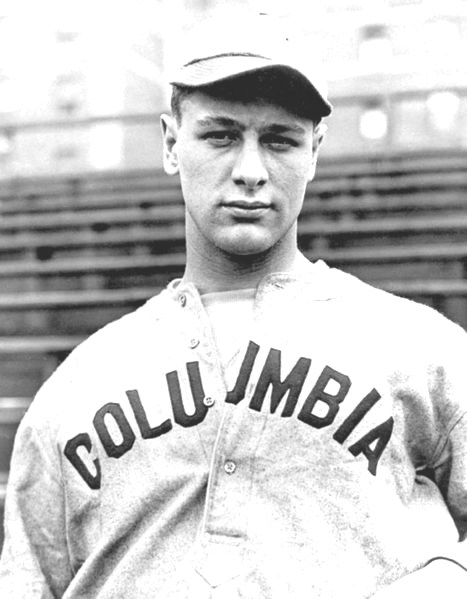
LOU GEHRIG

Baseball player Born in 1903 - Died in 1941


Lou Gehrig

Lou Gehrig was one of baseball's great players. His parents didn't want him to make a career of baseball. They thought it was a waste of time, but he loved the game. He was on his high school baseball team. A talent scout saw him and offered him a sports scholarship * in college.

The family didn't have much money because his father was ill. His mother was a cook at the college, and Lou waited on tables to help pay his way.

He started playing for the New York Yankees in 1923. His parents scraped together $14 for him to make the trip to spring training camp in New Orleans. When he got there, he started looking for a job, but the team paid him some money in advance. (They usually paid the players at the end of the training camp.) He was able to concentrate on practicing and improving his skills.


Baseball Hall of Fame

He improved so much that two different times, he was named American League Most Valuable player. He was called the
"Iron Horse".

He played in every game for 14 years without missing even one. He played over 2000 games. That was a record which wasn't broken for 50 years.

But then something bad happened. He could barely swing the bat and he couldn't run around the bases any more. He knew something was wrong. He went to specialists * . They said he had a disease called ALS. The long name for it is amyotrophic lateral sclerosis (am e uh TRO fic LAT er ul skler O sis). It attacks the nerve cells in the brain and spinal cord * and the person becomes unable to move. Death usually comes in two to five years.

He knew he would not be able to continue playing baseball, so he resigned * . The Yankees held a special day in Yankee Stadium on July 4, 1939 to honor him. In his speech he said his career in baseball made him "the luckiest man on the face of the earth". That same year he was voted into the Hall of Fame. Players were usually not voted into the Hall of Fame until after they had been retired for two years.

Even though he could no longer play baseball, he continued to work. He took a job serving on the New York State Parole Commission * . He kept working until he died in 1941.

It is said of him "his character was beyond reproach * ". This means no one could say anything bad about him, because he was such a good person.

The disease ALS became know as "Lou Gehrig's Disease".


This biography by Patsy Stevens, a retired teacher, was written in 2001.



A frequent question:
"Who wrote this biography and when was it written?"
Look on this Reference Citations Chart.


Work a Jigsaw Puzzle

Online Crossword Puzzle

Online Word Search

Online Word Scramble

Color Picture Online

Take the Test Online

Online Biography "Who Am I?"

PRINTABLES

Alphabetical Order

Lou Gehrig Word Search

Lou Gehrig Crossword Puzzle

Lou Gehrig - Word Scramble

Lou Gehrig - Word Match *

Lou Gehrig Study Sheet

Worksheet


Color a picture of Lou Gehrig

Print Lou Gehrig Test


RESEARCH LINKS

Lou Gehrig Official Website

Lou Gehrig's farewell speech

Lou Gehrig
National Baseball Hall of Fame

Gehrig legacy
Sports Century

Lou Gehrig, the Iron Horse
Baseball History.com

Lou Gehrig
at Wikipedia

Lou Gehrig
biography with audio version

Lou Gehrig
Baseball library.com

At biography.com search for Lou Gehrig.
Scroll the panel for the "Video & Audio Results".


From Word Central's Student Dictionary
by Merriam - Webster

(Pronunciation note: the schwa sound is shown by ə)

scholarship
Pronunciation: 'skahl-ər-"ship
Function: noun
: money given (as by a college) to a student to help pay for further education

resign
Pronunciation: ri-'zIn
Function: verb
1 : to give up by a formal or official act
2 : to give up an office or position.....

spinal cord
Function: noun
: the cord of nervous tissue that extends from the brain along the back in the cavity of the backbone, branches to form the spinal nerves, carries nerve impulses to and from the brain, and helps to control reflex actions

specialist
Pronunciation: 'spesh-(ə-)ləst
Function: noun
1 : a person who studies or works at a special occupation or branch of learning ....

reproach
Pronunciation: ri-'prOch
Function: noun
1 a : something that deserves blame or disgrace
b : loss of reputation :

commission
Pronunciation: kə-'mish-ən
Function: noun
.... a group of persons directed to perform some duty....

124832: Lou Gehrig: The Luckiest Man Lou Gehrig: The Luckiest Man
By David Adler / Harcourt Brace

Lou Gehrig's perseverance is legendary. During the fourteen years as a first baseman for the NY Yankees, he didnt miss a single game. His stamina earned him the nickname "The Iron Horse" and helped him to set what then was a world record. Lou loved baseball and considered himself a very lucky man, even though on his 36th birthday he was diagnosed with a rare and fatal disease. This powerful biography traces Lou Gehrig's life, capturing his strength, modestly, and dignity for which this remarkable man will always be remembered. Recommended for ages 6 to 9.


268938: Luckiest Man: The Life and Death of Lou Gehrig Luckiest Man: The Life and Death of Lou Gehrig
By Jonathan Eig / Simon & Schuster Trade Sales

Lou Gehrig was a baseball legend -- the Iron Horse, the stoic New York Yankee who was the greatest first baseman in history, a man whose consecutive-games streak was ended by a horrible disease that now bears his name. But as this definitive new biography makes clear, Gehrig's life was more complicated -- and, perhaps, even more heroic -- than anyone really knew. Drawing on new interviews and more than two hundred pages of previously unpublished letters to and from Gehrig, Luckiest Man gives us an intimate portrait of the man who became an American hero: his life as a shy and awkward youth growing up in New York City, his unlikely friendship with Babe Ruth (a friendship that allegedly ended over rumors that Ruth had had an affair with Gehrig's wife), and his stellar career with the Yankees, where his consecutive-games streak stood for more than half a century. What was not previously known, however, is that symptoms of Gehrig's affliction began appearing in 1938, earlier than is commonly acknowledged. Later, aware that he was dying, Gehrig exhibited a perseverance that was truly inspiring; he lived the last two years of his short life with the same grace and dignity with which he gave his now-famous "luckiest man" speech. Meticulously researched and elegantly written, Jonathan Eig's Luckiest Man shows us one of the greatest baseball players of all time as we've never seen him before.


A LIBRARY OF
ONLINE BOOKS and BOOK PREVIEWS

Preview the Amazon books using the links below.

Lou Gehrig, A Biography
by William C. Kashatus (selected pages)

Lou Gehrig, 1000 Readers
by Carole Marsh (selected pages)

Lou Gehrig, Baseball Hall of Famers
by Robert Greenberger (selected pages)

Lou Gehrig, A Life of Dedication, easy biography
by Jennifer Boothroyd (selected pages)

Lou Gehrig, Sports Heroes and Legends
by Kevin Viola (selected pages)

Lou Gehrig: One of Baseball's Greatest
by Guernsey Van Riper (selected pages)


Page Comments

Most Recent Comments   ( See more comments on this page )
2012-10-12
Great stuff on your video here is a link you will like http://www.sportsenthusists.com/category/m-l-b/
Stuart
2010-02-20
Question about MLA format. Look here: http://gardenofpraise.com/biographydates.htm

Leave a Comment       View all Comments


Biographies in this Series

Reference citations information for these biographies


Presidents of
the United States
George Washington John Adams Thomas Jefferson James Madison James Monroe Andrew Jackson
  Martin Van Buren Abraham Lincoln Theodore Roosevelt Franklin D. Roosevelt Harry S. Truman Dwight D. Eisenhower
  John F. Kennedy Lyndon B. Johnson Jimmy Carter Ronald Reagan Barack Obama Calvin Coolidge
American Patriots Benjamin Franklin Francis Scott Key Deborah Sampson Molly Pitcher
World Leaders Constantine Alexander the Great Winston Churchill
Inventors Alexander Graham Bell Johann Gutenberg Cyrus McCormick The Wright Brothers Henry Ford Thomas A. Edison
  Sequoyah Nikola Tesla Michael Faraday Dean Kamen Jack Kilby Leonardo Da Vinci
  Donald O'Neal
Explorers Christopher Columbus Meriwether Lewis Robert Peary John Muir Matthew Henson Sir Edmund Hillary
  Kit Carson Johnny Appleseed Daniel Boone
Women who made
a difference
Clara Barton Helen Keller Florence Nightingale Joan of Arc Amelia Earhart Annie Oakley
  Susan B. Anthony Elizabeth Keckly Harriet Tubman Anne Frank Eleanor Roosevelt Madam C.J. Walker
  Sadako Sasaki Henrietta Lacks        
Scientists George Washington Carver Sir Isaac Newton Marie Curie Louis Pasteur Albert Einstein Galileo
  Lise Meitner Norman Borlaug Benjamin Banneker
Educators Noah Webster Booker T. Washington Aristotle Mary McLeod Bethune
Physicians Hippocrates Walter Reed Albert Schweitzer
Religious Leaders George Muller Increase Mather
Athletes Lou Gehrig Wilma Rudolph Tiger Woods Michael Phelps
Civil Rights
Leaders
Martin Luther King Rosa Parks Sojourner Truth Frederick Douglass Mary Ann Shadd Cary James Forten
  Gandhi César Chávez William Wilberforce Nelson Mandela
Composers Beethoven Mozart
Authors Laura Ingalls Wilder Samuel Clemens (Mark Twain) Ernest Hemingway Greg Mortenson Phillis Wheatley
Artists John James Audubon Gutzon Borglum Ansel Adams Dale Chihuly Van Gogh Michelangelo
  Rembrandt Grandma Moses Cassatt Renoir Cezanne Rockwell

Home


Back to Famous Leaders


Picture courtesy of Wikimedia Commons.

Puzzles on these pages courtesy of
Songs of Praise and Armored Penguin

*Word Match Solution