Hippocrates
Father of Medicine
Born in 460 B.C. - Died in 377 B.C.
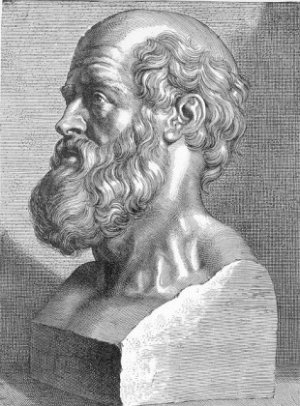
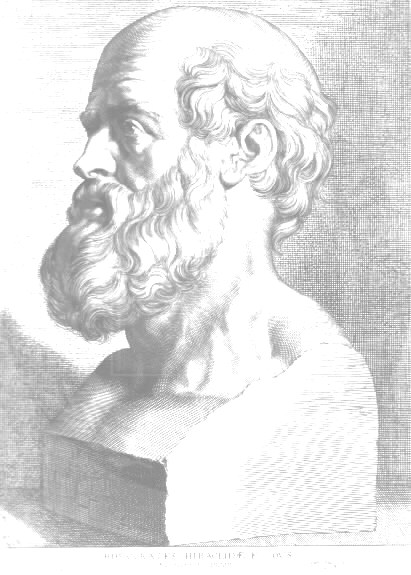
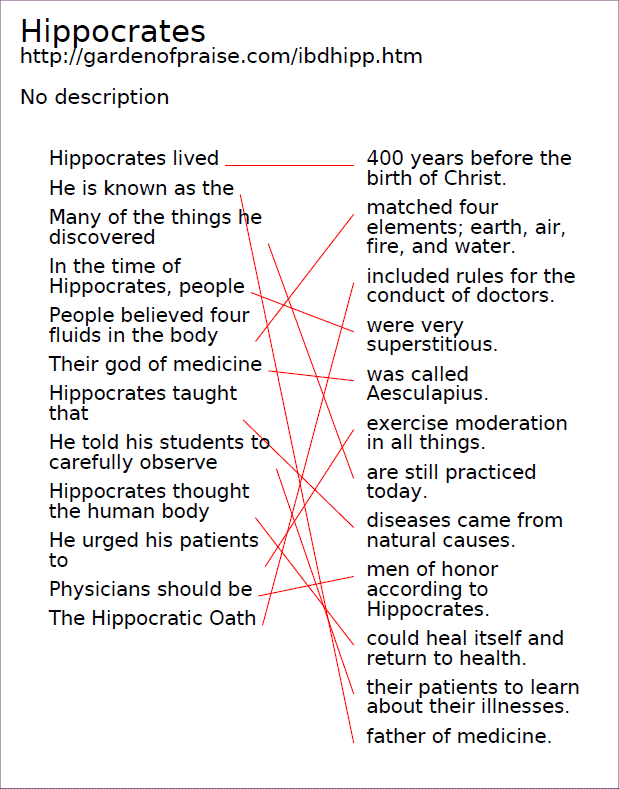
Hippocrates (hih POK ruh teez) lived 400 years before the birth of Christ.
He is known as the father of medicine because many of the things he
discovered are still practiced today.
During the time when Hippocrates lived, people were very superstitious.They believed there were four fluids in the body which matched
four elements; earth, air, fire and water. They would carry sick
people to the temple because they thought the god of medicine, Aesculapius
(es kyoo LAY pe us) could heal
them. They would say magic words over the patient to try and heal them.
Hippocrates taught that diseases came from natural causes. He had
observed many patients and carefully recorded their symptoms and the
way their illnesses developed. He would look at the color of the skin,
and how the eyes looked. He would look for fevers and chills. He described many illnesses including
pneumonia, tetanus, tuberculosis, arthritis, mumps,
and malaria.
He told his students to carefully observe their patients and to learn
from the things they had observed. He said the human body could
heal itself and could return itself to good health. The patient was
given something to relieve pain, but nothing else was done.
He told his patients they should eat a moderate amount of food;
not too much and not too little. A moderate amount of exercise was
recommended. Patients were encouraged to walk for exercise.
Doctors were told to make sure their hands were clean before they
treated patients. He said the operating room should be well lighted
and look cheerful. He thought patients in good spirits would
heal faster.
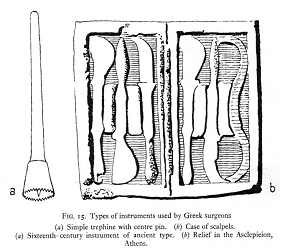
Doctors were told to make sure their hands were clean before they
treated patients. He said the operating room should be well lighted
and look cheerful. He thought patients in good spirits would
heal faster.
Physicians should be men of honor, according to Hippocrates. He encouraged
them to work as hard as possible for the good of the sick.
The Hippocratic (hip uh CRAT ick) Oath was named for him. It included
rules of conducts for doctors and even today doctors still honor a form
of the oath.
This biography by Patsy Stevens, a retired teacher, was written in 2001.
Activities
Other Activities
Play an Online Game at Quia
Dictionary
From
Word Central's Student Dictionary
by Merriam - Webster
(Pronunciation note: the schwa sound is shown by ə)
superstitious, influenced by superstition
Pronunciation: 'soo-pər-'stish-ən
Function: noun
a belief or practice resulting from ignorance, fear of the
unknown, or trust in magic....
pneumonia
Pronunciation: n(y)u-'mO-nyə
Function: noun
: a disease of the lungs marked by inflammation
and congestion
and caused by infection or irritants
tetanus
Pronunciation: 'tet-ə-nəs
Function: noun
a dangerous infectious disease marked by stiffness and
spasms of the muscles
with locking of the jaws and caused by a
poison made by a bacterium
that usually enters the body
through a wound....
tuberculosis
Pronunciation: t(y)u-'bər-kyə-'lO-səs
Function: noun
: a disease of human beings and some other vertebrates
caused
by a bacterium and usually marked by wasting, fever, and
formation of cheesy tubercles
that in human beings occur mostly
in the lungs
arthritis
Pronunciation: ahr-'thrIt-əs
Function: noun
: inflammation of the joints
mumps
Pronunciation: 'məm(p)s
Function: noun singular or plural
: a contagious disease caused by a virus and marked by fever
and by swelling especially of salivary glands
malaria
Pronunciation: mə-'ler-E-ə
Function: noun
: a disease caused by protozoan parasites in the red blood cells,
passed from one individual to another by the bite of mosquitoes,
and marked by periodic attacks of chills and fever
Research Links
Ancient Greek Medicine
Works by HippocratesThe Internet Classics Archive
Digital HippocratesA collection of Ancient Medical texts.
Medicine in Ancient Greecefrom Indiana University
Hippocrates (audio)
The Hippocratic Oath (audio)
Engines of Our Ingenuity.
Medical History of the Presidents of the United States
"Fathers of Biology"online book by Charles McRae
Videos
Books
Press "Go" to search for books about
Hippocrates.
Library
A LIBRARY OF
ONLINE BOOKS and BOOK PREVIEWS
Order the following books from Amazon.
Fathers of Biologyby Charles McRae (public domain, full view)
Great Scientists and Discoveriesby Ron Shaw (selected pages) Order
here
Hippocrates, Making the Way for Medicineby Connie Jankowski (selected pages)
Lexi and Hippocratesfiction by Marian Keen (selected pages)
Credits and Solutions
Picture courtesy of
Wikimedia Commons.
You do not need permission to use the picture on this page. It is in the public domain.
Puzzles on these pages courtesy of
Songs of Praise and
Armored Penguin
* Word Match Solution
This page displayed 172,075 times.
This is a mobile page of
Garden of Praise. You are using a desktop computer. Try viewing the
mobile pages on your smart phone.







 A frequent question: