NOAH WEBSTER

Born in 1758 - Died in 1843


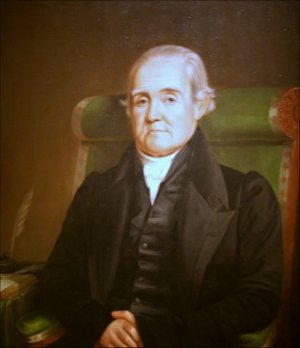
Noah Webster

Noah Webster was born in Connecticut. He was a descendant of John Webster, who had been the state governor in the mid-1600's. He lived during the time of George Washington. He attended law school for a while, then he went home and found his family needed help. He took a job teaching school to earn money to support them.

The school was in a shack and as the teacher, he had to do everything. He had to clean and repair the building as well as teach. But he wanted to set a good example for his students, so he did every task cheerfully. He was a good teacher. Instead of flogging * his students to get them to learn, he rewarded them.

Later when he was a schoolmaster in Hartford, he lived with a judge who had a large library. He was able to study law using the judge's books. He became a lawyer, but what he really wanted to do was to teach others.

He decided to write a spelling book and a grammar book. More than 100 million copies of the spelling book were sold. It became known as the Blue-backed Speller.

He rode by horseback and in stagecoaches from town to town in the original 13 states showing people his books. He called them "American books for American children". He would get important people to say good things about his books, then he would show these letters to schools and give them sample copies of the books. The schools usually ordered hundreds of the books for their students.

He had observed that the people in America spoke many languages and they could not understand each other. They would get into fights because of these misunderstandings * .

He thought there needed to be one language;
a "mother tongue" * , so that people could work together and be united. He made a dictionary for the people.

He changed some of the spellings of words. He changed words such as "musick" to "music", "centre" to "center",
and "plough" to "plow". He wanted to change "tongue" to "tung" and "women" to "wimmen", but people didn't want to make the changes, so he kept the old spellings of those words.

He changed the way people pronounced "tion". The word "salvation" had been pronounced "sal VA she un" and he said it was alright to say "sal VA shun".


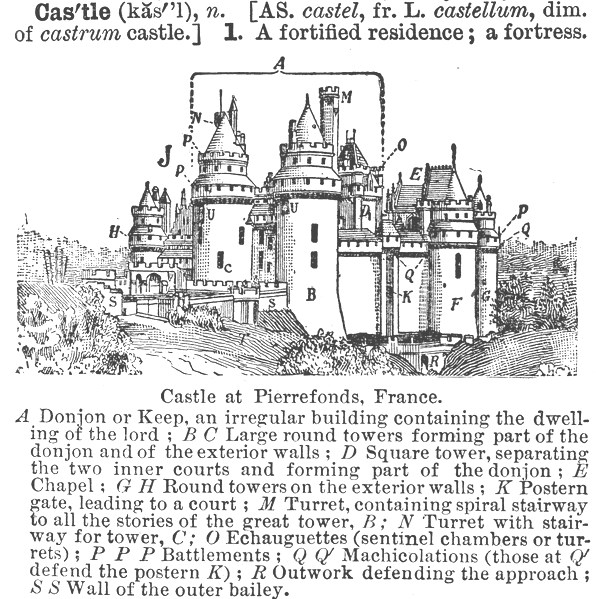
A page from Webster's dictionary 1900

When he started working on his dictionary, he wanted it to be accurate * . He wanted everything in it to be right. He spent more than 20 years and thousands of dollars researching the origins * of words. He wanted to know where the words first started and how we came to be using them. He looked in libraries in England, France and the United States.

He did all the work himself.

When the dictionary was finished, it had 70,000 English words in it. He called it "An American Dictionary of the English Language". It has sold more copies than any English book except the Bible.

Later the Merriam family bought the right to publish the dictionary and it became known as the Merriam - Webster dictionary.

Webster in addition to creating a dictionary helped to create an American nation.


A frequent question: "Who wrote this biography and when was it written?" Look on this Reference Citations Chart.


Work a Jigsaw Puzzle

Online Crossword Puzzle

Online Word Search

Online Word Scramble

Color Picture Online

Take the Test Online

Online Jeopardy

Online Biography "Who Am I?"

PRINTABLES

Noah Webster Word Search

Noah Webster Crossword Puzzle

Noah Webster - Word Scramble

Noah Webster Study Sheet

Worksheet

Color a Webster dictionary page .

Print Noah Webster Test


Noah Webster
at Wikipedia

Noah Webster
from Great Site.com

Noah Webster
lesson planning article

Noah Webster
birthplace and homepage

The Hornbook and Its Use in America

The American Spelling Book
online book by Noah Webster 1807

Noah Webster
online book by Horace E. Scudder

Noah Webster's "Dictionary of the English Language"
online book
(You can enlarge the print by clicking on the "+" sign by the word "zoom" at the top of the page.)

Colonial games and toys


1600553: Defining Noah Webster: A Spiritual Biography Defining Noah Webster: A Spiritual Biography
By K. Alan Snyder / Xulon Press

In this masterful biography, professor and political historian K. Alan Snyder unfolds the life, times and political thought of Noah Webster, America's premier post-revolutionary educator. Snyder recounts how Webster rose from obscurity to become the father of early American education, and how his dramatic conversion to Christianity influenced the nation from colonial times to today. The son of a penniless farmer, and descendant of Pilgrim WIlliam Bradford, Webster achieved astounding succcess in influencing early-American intellectual and moral thought. But much about Noah Webster's life will come as a surprise to readers. As an entrepreneurial schoolmaster, Webster not only compiled and edited the nation's first textbooks and dictionaries, but he also championed the use of the Bible in schools. After his conversion, he abandoned the rational philosophies of the Enlightenment and evangelized his convctions that biblical truth out to be the bedrock for all civil government and education.

79342: Webster"s Advice to the Young Webster's Advice to the Young
By David Barton / Wallbuilders

Noah Webster was an influential Founding Father, serving as a soldier during the American Revolution and as a legislator in two states after the Revolution. He was the first Founding Father to call for a Constitutional Convention and was personally responsible for the copyright clause found in Article I, Section 8, of the U.S. Constitution. Like most of the Founding Fathers, Webster understood that the ability of our new government to endure would depend upon the quality of our educational system. Consequently, he became a leading educator and for almost six decades authored textbooks designed to transmit to subsequent generations the principles embodied in the government he had helped create. Two works he authored to help train future generations were his "Moral Catechism" (1783), and later his "Advice to the Young". These two powerful works are reprinted in this booklet and are beneficial not only for America's current students, but for former students never exposed to these words in their school textbooks. Recommended for ages 10 and up.

91424: Noah Webster, Sower Series Noah Webster, Sower Series
By Mott Media, Llc

As a boy, Noah was fascinated with language and education. He was troubled by the lack of interest shown by others in formal schooling, and the lack of books and proper facilities bothered him even more. When the fires of the Revolution broke out in the early 1770's, Noah was a student at Yale. Young and impressionable, he was singed by the flames of patriotism. He longed for a chance to join liberty's cause. He wrote down his thoughts about freedom and government, sharing them with leaders who would put together the United States Constitution. Many of his ideas were incorporated into the document. But more than a spokesman for democratic government, Noah Webster was a champion for youth and education. He knew what books needed to be written, wrote them, and fought for their acceptance within the school framework. Today, Webster is with us still. But he merits a place of honor beyond a name stamped on dictionaries around the world. He was a man who served his fellow man and his country with unselfish devotion. More importantly, he served his God with faith and love. For ages 9 to 13.


From Word Central's Student Dictionary
by Merriam - Webster

(Pronunciation note: the schwa sound is shown by ə)

flogging, flog
Pronunciation: flahg
Function: verb
: to beat severely with or as if with a rod or whip ...

misunderstanding, misunderstand
Pronunciation: (")mis-"ən-dər-'stand
Function: verb
...1 : to fail to understand 2 : to interpret incorrectly

mother tongue
Function: noun
1 : one's native language
2 : a language from which another language develops

accurate
Pronunciation: 'ak-yə-rət
Function: adjective
1 : free from mistakes especially as the result of care
2 : agreeing exactly with truth or a standard, correct...

origins, origin
Pronunciation: 'or-ə-jən
Function: noun
... a : a rising, beginning, or coming from a source
b : basic source or cause...


Page Comments

Please leave a comment for this page.

View all Comments


Biographies in this Series

Reference citations information for these biographies


Presidents of
the United States
George Washington John Adams Thomas Jefferson James Madison James Monroe Andrew Jackson
  Abraham Lincoln Theodore Roosevelt Franklin D. Roosevelt John F. Kennedy Ronald Reagan Barack Obama
American Patriots Benjamin Franklin Francis Scott Key Deborah Sampson
World Leaders Constantine Alexander the Great Winston Churchill
Inventors Alexander Graham Bell Johann Gutenberg Cyrus McCormick The Wright Brothers Henry Ford Thomas A. Edison
  Sequoyah Nikola Tesla
Explorers Christopher Columbus Meriwether Lewis Robert Peary John Muir Matthew Henson Sir Edmund Hillary
  Kit Carson "Johnny Appleseed"
Women who made
a difference
Clara Barton Helen Keller Florence Nightingale Joan of Arc Amelia Earhart Annie Oakley
  Susan B. Anthony Elizabeth Keckly Harriet Tubman Anne Frank Eleanor Roosevelt Madam C.J. Walker
Scientists George Washington Carver Sir Isaac Newton Marie Curie Louis Pasteur Albert Einstein Galileo
  Lise Meitner Norman Borlaug
Educators Noah Webster Booker T. Washington Aristotle
Physicians Hippocrates Walter Reed Albert Schweitzer
Religious Leaders Increase Mather
Athletes Lou Gehrig Wilma Rudolph Tiger Woods Michael Phelps
Civil Rights
Leaders
Martin Luther King Rosa Parks Sojourner Truth Frederick Douglass Mary Ann Shadd Cary James Forten
  Gandhi César Chávez
Composers Beethoven
Authors Laura Ingalls Wilder Samuel Clemens (Mark Twain) Ernest Hemingway
Artists John James Audubon Gutzon Borglum Ansel Adams

Home


Back to Famous Leaders


Picture courtesy of Wikimedia Commons.

Puzzles on these pages courtesy of
Songs of Praise and Armored Penguin