![]() HARRIET TUBMAN
|
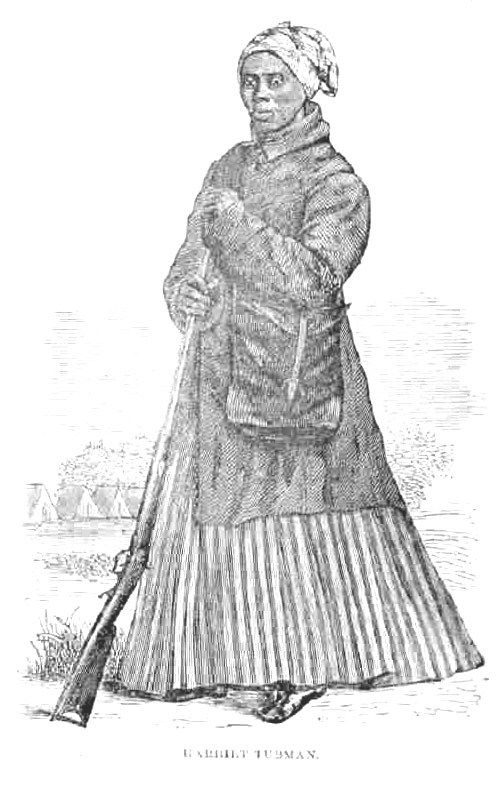
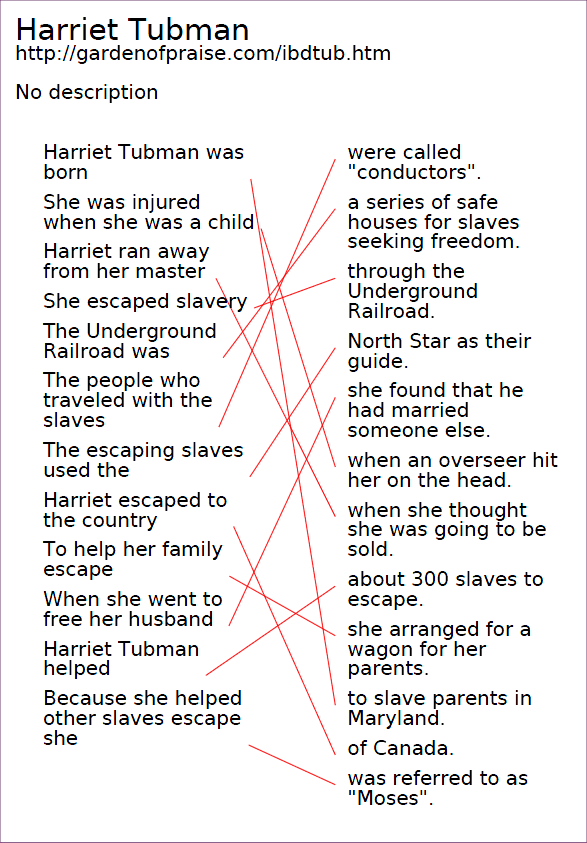
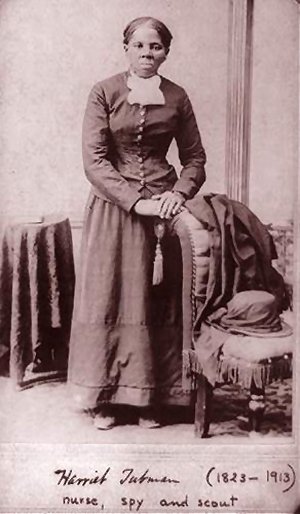
Harriet Tubman was born around 1820 in Maryland. Her parents were slaves, so she also was a slave when she was born. She had to work even when she was a little child. When she was twelve years old, she suffered a serious injury when an overseer threw a heavy weight which hit her in the head. After that incident she slept a lot. This condition remained with her the rest of her life. People with narcolepsy will suddenly fall asleep wherever they happen to be.
When she was 25, she married John Tubman who was not a slave, but a free African American.
Harriet was afraid she was going to be sold and sent to the South, so she decided to run away. A white neighbor gave her some names of people she could contact to help her. She was about to escape through the Underground Railroad.
Map of the Underground Railroad |
To understand the story of Harriet Tubman we first need to learn something about the Underground Railroad. It was not a railroad, and it was not under the ground. It was a network of "safe houses" where slaves could flee from one house to the next until they made their way to the Canadian border. The people helping them had to do it secretly, so it was an "underground" or covert* operation. |
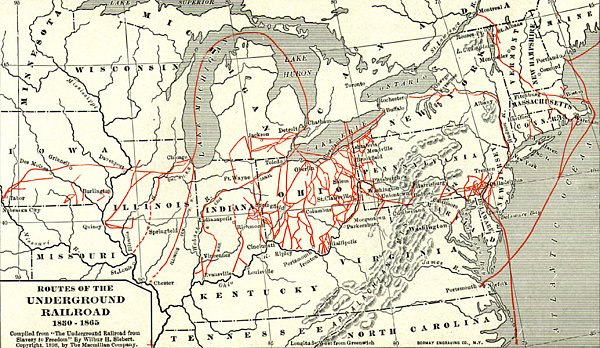
The safe houses were called "stations" or "depots". The owners of the houses were called "stationmasters". A compassionate* religious group of Quakers were stationmasters as well as certain free blacks who were sympathetic to the slaves.
The people who traveled with the slaves to help them escape were called "conductors".
The slaves knew they had to go north to find freedom. They used the North Star, Polaris*, as their guide. They would use the coded words in the song "Follow the Drinking Gourd" to find their way. (The drinking gourd was the Big Dipper in the sky from which they could locate the North Star.)
During a forty year period about 100,000 slaves escaped from the South through the Underground Railroad.
Harriet contacted a person her friend had recommended, and through a series of safe houses made her way to Canada where she became a free woman. Her next concern was to help her family also become free. She returned to Maryland again and again freeing her sister and her sister's two children, her brother and two other men. When she went to rescue her parents who were seventy years old, she had to arrange for a wagon because they were too frail to make the trip on foot.
She made a trip to free her husband, John, only to find that he had married another woman! It made her very sad that he had rejected her and chosen another to be his wife, but she decided to devote herself to helping others gain freedom. She later married Nelson David, a former slave who was a Union soldier.
Harriet made nineteen trips as a "conductor", risking her life every time, and successfully freed about 300 slaves. She carried a gun and threatened any slave who wanted to turn back.
A reward of $40,000 was offered to any bounty hunter who brought Harriet in to the authorities, but she managed to avoid capture. She was such a brave woman! Harriet became known as "Moses" because she was freeing her people just as Moses freed the children of Israel from Egyptian slavery.
She made friends with many influential* people including abolitionists* John Brown and Frederick Douglas. She befriended Senator William H. Seward from New York. He and his wife provided a house where she moved her parents down from Canada. She later was able to buy the home and stayed there when she was not on the road helping slaves escape.
During the Civil War Harriet worked for the Union Army. Sometimes she worked as a cook, sometimes she served as a nurse, and even worked as a spy! After the war she returned to her home in Auburn, New York.
Harriet Tubman died at the age of 93. After her death she received many honors. A ship was named for her; the Liberty Ship Harriet Tubman, and in 1995 the federal government issued a commemorative* postage stamp in her honor.
Fergus M. Bordewich, the author of "Bound for Canaan: The Underground Railroad and the War for the Soul of America" states that myths grew up around the Underground Railroad. He says one fact that can't be substantiated is that quilts with secret code in the squares were displayed to indicate safe houses. View excerpts from the book.
You might like to read an article Underground Warfare: A New Museum Sheds Light on the History of the Underground Railroad
. (When you get to Amazon view the "Search Inside" to see the contents of the book.)
![]()
Courage to Run: A Story Based on the Life of Harriet Tubman
By Wendy Lawton / Moody Publishers
Born Arminta Ross, young Harriet Tubman (named after her mother when she was full-grown) was a faithful strong girl growing up in the late 1800's as a slave in the south. Her faith was at the center of everything she did and she was tested at every turn. The story of her childhood is a record of courage and bravery. Even more, it's the story of God's faithfulness as he prepares her to eventually lead more than 300 people out of slavery through the Underground Railroad. For ages 8-12.
Harriet Tubman
By George Sullivan / Scholastic Trade
This book tells the exciting story of Tubman's life using interviews with Harriet as well as the words of her freinds. Hear Tubman's story as if you were really there.
From Word Central's Student Dictionary
by Merriam - Webster
(Pronunciation note: the schwa sound is shown by &)
covert
Pronunciation: kO-'v&rt, 'k&v-&rt
Function: adjective
not openly made or done as in a covert military operation
compassion
Pronunciation: k&m-'pash-&n
Function: noun
sorrow or pity caused by the suffering or misfortune of another
: SYMPATHY
com pas sion ate /-'pash-(&-)n&t/ adjective
Polaris
Pronunciation: p&-'lar-&s, -'lahr-
Function: noun
the North Star
influential
Pronunciation: "in-(")floo-'en-ch&l
Function: adjective
having influence
abolitionist
Pronunciation: ab-&-'lish-(&-)n&st
Function: noun
a person who is in favor of abolishing especially slavery
commemorative
Pronunciation: k&-'mem-&-r&t-iv
Function: adjective
intended to commemorate a person, thing, or event
as a commemorative postage stamp
Biographies in this Series
Presidents of the
United StatesGeorge Washington
1st U.S. President
John Adams
2nd U.S. President
Thomas Jefferson
3rd U.S.President
James Monroe
5th U.S. President
Andrew Jackson
7th U.S. President
Abraham Lincoln
16th U.S.President
Franklin D. Roosevelt
32nd U.S. President
John F. Kennedy
35th U.S. President
James Madison
4th U.S. President
Theodore Roosevelt
26th U.S. President
American Patriots Benjamin Franklin
patriot and statesman
Francis Scott Key
Star Spangled Banner
Deborah Sampson
woman soldier in the Revolutionary War
World Leaders Constantine
Roman Emperor
Alexander the Great
conqueror
Winston Churchill
British Prime Minister
Inventors Alexander Graham Bell
telephone
Johann Gutenberg
printing press
Cyrus McCormick
mechanical reaper
The Wright Brothers
first airplane
Henry Ford
Automaker
Thomas A. Edison
electric light bulb
Sequoyah
Cherokee alphabet
Nikola Tesla
700 patents
. Explorers Christopher Columbus
explorer
Meriwether Lewis
explorer
Robert Peary
Arctic explorer
John Muir
Naturalist
Matthew Henson
Arctic Explorer
Sir Edmund Hillary
Mr.Everest
Kit Carson
Indian agent
"Johnny Appleseed"
orchardist
. Women who made
a differenceClara Barton
founder of the Red Cross
Helen Keller
overcame blindness & deafness
Florence Nightingale
founder of nursing profession
Joan of Arc
religious and military leader
Amelia Earhart
Aviator
Annie Oakley
sharpshooter
Susan B. Anthony
Suffragette
Elizabeth Keckly
Seamstress
Harriet Tubman
deliverer of slaves
Anne Frank
Diarist
Eleanor Roosevelt
Humanitarian
. Scientists George Washington Carver
botanist and educator
Sir Isaac Newton
explained gravity and properties of light
Marie Curie
scientist, physicist
Louis Pasteur
Biologist
Albert Einstein
physicist, genius
Galileo
Astronomer, physicist
Educators Noah Webster
writer of dictionary
Booker T. Washington
leader and educator
Aristotle
Greek philosopher
Physicians Hippocrates
father of medicine
Walter Reed
discovered cause of yellow fever
Albert Schweitzer
humanitarian
Religious Leaders Increase Mather
Salem witch trials
. Athletes Lou Gehrig
baseball player
Wilma Rudolph
Olympic gold medal winner
Tiger Woods
golfer
Michael Phelps
Olympic swimmer
. . Civil Rights
LeadersMartin Luther King
civil rights leader
Rosa Parks
bus desegregation
Sojourner Truth
Former slave
Frederick Douglass
Abolitionist
Mary Ann Shadd Cary
Civil rights leader
James Forten
Inventor, abolitionist
Composers Beethoven
composer
Artists John James Audubon
artist and naturalist
Gutzon Borglum
sculptor, Mount Rushmore
Ansel Adams
photographer
Home
Back to Famous Leaders
Public domain picture from the Library of Congress
Coloring picture courtesy of Wikipedia.
![]()
Puzzles on these pages courtesy of
Songs of Praise and Armored Penguin