
Wilma Rudolph
Track Star
Born in 1940 - Died in 1994
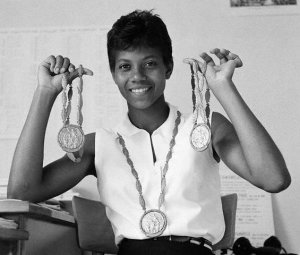
When Wilma Rudolph was four years old, she had a disease called
polio which causes people
to be crippled and unable to walk.
To make matters worse, her family was poor and could not afford
good medical care. She was from a large family. She was the
20th child of 22 children. Her father was a railroad
porterand her mother was a maid.
Her mother decided she would do everything she could to help
Wilma to walk again. The doctors had said she would not
be able to walk. She took her every week on a long bus trip to
a hospital to receive therapy.
It didn't help, but the doctors
said she needed to give Wilma a massage every day by rubbing her legs. She
taught the brothers and sisters how to do it, and they also rubbed her
legs four times a day.
By the time she was 8, she could walk with a leg brace. After that,
she used a high-topped shoe to support her foot. She played basketball
with her brothers every day.
Three years later, her mother came home to find her playing basketball
by herself bare-footed. She didn't even have to use the
special shoe.
A track coach encouraged her to start running. She ran so well that
during her senior year in high school,
she qualified for the 1956
Olympics in Melbourne, Australia. She won a bronze medal in the
women's 400-meter relay.
In 1959, she qualified for the 1960 Olympic Games in Rome by setting a
world's record in the 200-meter race. At the Olympics that year
she won two gold medals; one for the 100-meter race and one for
the 200-meter race.
Then she sprained her ankle, but she ignored the
pain and helped her team to win another gold medal for
the 400-meter
relay! In the picture above you see the three gold medals she won
at the Rome Olympics.
She retired from running when she was 22 years old, but she went
on to coach women's track teams and encourage young people.
Wilma thought God had a greater purpose for her than to win
three gold medals. She started the Wilma Rudolph Foundation to help
children learn about discipline and hard work.
She died of brain cancer in 1994. Even though she is no longer alive,
her influence still lives on in the lives of many young people who
look up to her.
This biography by Patsy Stevens, a retired teacher, was written in 2001.
Activities
Other Activities
Play an Online Game at Quia
Dictionary
From
Word Central's Student Dictionary
by Merriam - Webster
(Pronunciation note: the schwa sound is shown by ə)
polio (poliomyelitis)
Pronunciation: 'pO-lE-'O-'mI-ə-'lIt-əs
Function: noun
: an infectious virus disease marked by inflammation of nerve
cells in the spinal cord
accompanied by fever and often paralysis
and wasting of muscles,
called also infantile paralysis
porter
Pronunciation: 'pOrt-ər
Function: noun
1 : a person who carries baggage (as at a hotel)
2 : a railroad employee who waits on passengers....
therapy
Pronunciation: 'ther-ə-pE
Function: noun
: the treatment of disease especially by massage, exercise,
water, or heat
massage
Pronunciation: mə-'sahzh, - 'sahj
Function: noun
: treatment (as of the body) by rubbing, stroking, kneading, or
tapping
Olympic Games
Function: noun plural
: a series of international athletic contests held in a different
country once every four years
Research Links
Wilma RudolphBiography.com
Wilma RudolphEncyclopedia of World Biography
Wilma Rudolphat Wikipedia
Wilma Rudolph Chronology
My Hero, Wilma Rudolph
Wilma Rudolph, ESPN
Wilma Rudolph Quotes
Wilma Rudolphprintable book
Videos
Books
Press "Go" to search for books about
Wilma Rudolph.
Library
A LIBRARY OF
ONLINE BOOKS and BOOK PREVIEWS
Order the following books from Amazon.
Wilma Rudolph (A&E)by Amy Ruth (selected pages) Order
here
Wilma Rudolphby Corinne J. Naden, Rose Blue (selected pages) Order
here
Stick to It!: The Story of Wilma Rudolph (Spyglass Books)by David Conrad (selected pages) Order
here
Wilma Rudolph, Newmaster Reading Comprehension, Homework Helpers, Grade 3by Mary Newmaster (selected pages) Order
here
Life-Skills for Middle School, Vol. 3 (Learner's Workbook)by ARISE Foundation (selected pages) Order
here
Wilma Rudolphby Victoria Sherrow (selected pages)
Wilma Rudolphby Thomas Streissguth (selected pages)
Wilma Rudolph Champion Athleteby Tom Biracree (selected pages)
Wilma Rudolph Olympic Track Starby Lee Engler (selected pages)
Wilma Rudolphby Maureen Smith (selected pages)
Wilma Rudolphby Jo Harper (selected pages)
Wilma Rudolph (First Biographies)by Eric Braun (selected pages)
Credits and Solutions
Picture courtesy of Corbis.com
Puzzles on these pages courtesy of
Songs of Praise and
Armored Penguin
* Word Match Solution
This page displayed 452,384 times.
This is a mobile page of
Garden of Praise. You are using a desktop computer. Try viewing the
mobile pages on your smart phone.






 A frequent question:

