![]() ALEXANDER GRAHAM BELLBorn 1847 - Died 1922![]()
|
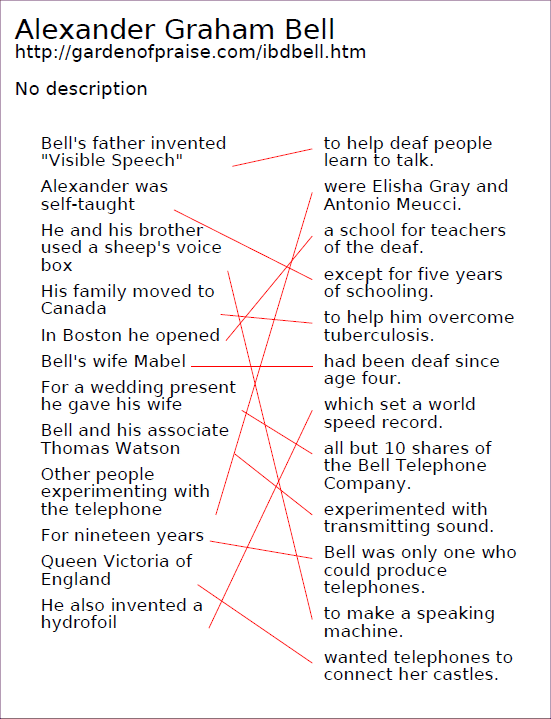
Alexander Graham Bell was born in Scotland. His mother, who was deaf, was a musician and a painter of portraits. His father, who taught deaf people how to speak, invented "Visible Speech". This was a code which showed how the tongue, lips, and throat were positioned to make speech sounds. Graham, or "Aleck", as his family called him, was interested in working with the deaf throughout his life.
He only attended school for five years; from the time he was 10 until he was 14, but he never stopped learning. He read the books in his grandfather's library and studied tutorials * .
When he was a teen-ager, he and his brother Melly used the voice box of a dead sheep to make a speaking machine that cried, "Mama!" This created even more interest in human speech and how it worked.
When he was in his early 20's, his two brothers died of tuberculosis * . Bell himself had the disease and his father moved the family to Canada looking for a better climate in which to live. Bell recovered from the disease.
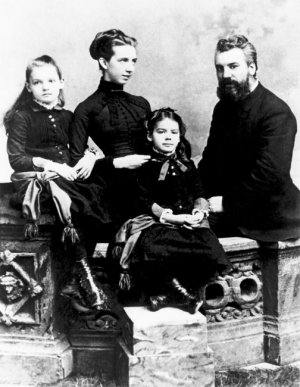
Two years later he went to Boston to open a school for teachers of the deaf and then became a professor at Boston University. It was at this time that he met Mabel Hubbard, one of his students who was 10 years younger than he. Mabel had become deaf at the age of four due to scarlet fever. Five years later they were married. At the wedding ceremony he gave her a gift of all but 10 shares of the stock in the newly formed company called Bell Telephone Company. They had three sons.
Thomas Watson became an associate of Bell. He made parts and built models of Bell's inventions. One day while they were working Bell accidently heard the sound of a plucked reed * coming over the telegraph wire. Watson had been tuning the metal reeds in the next room. Bell drew up a plan for the telephone and they continued to experiment. The next day he transmitted the famous words, "Mr. Watson, come here. I want you!" A few months later on Feb. 14, 1876, he applied for a patent on his telephone.
He knew he would have to work quickly to get the patent * because other people were also trying to make an invention to transmit the human voice. Elisha Gray claims he too invented the telephone, but Bell got to the patent office an hour or so before he did. It is said that Antonio Meucci also succeeded with the invention before Bell.
![]()
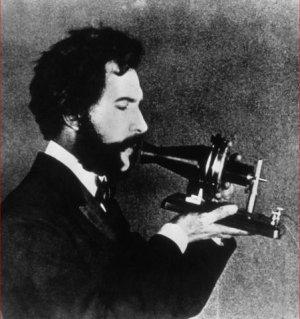
A copy of the orginal
Bell phone
photo credit*Because Bell had the patent, he had the right to be the only one to produce telephones in the U.S. for the next 19 years.
He showed the invention to Queen Victoria of England and she wanted lines to connect her castles.
By 1917, nearly all of the United State had telephone service.
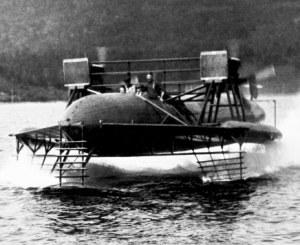
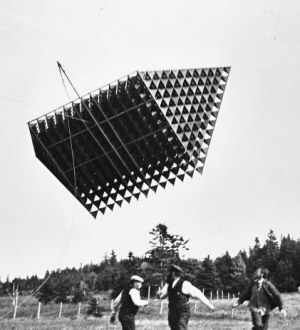
He continued to invent other things. He developed a method of making phonograph * records on a wax disc. He made an iron breathing lung, and a device for locating icebergs at sea. He experimented with sheep. He was interested in kites that could lift a man, and he invented a hydrofoil * which set a world speed record of over 70 miles per hour.
He along with others started the National Geographic Society and he served as its president for several years.
He became a U.S. citizen, but he died in Canada at the age of 75.
Telephone photo licensed under Creative Commons* by Rama at Wikipedia
![]()
Cyber Telephone Museum
old telephones
Alexander Graham Bell Family Papers
Library of Congress
Bell's drawing of his telephone
Alexander Graham Bell: America Listens
video at Biography.com
Bell's Telephone
from the Franklin Institute Online
Alexander Graham Bell
from PBS
Alexander Graham Bell Timeline
More about Bell and Kites from Design Technology
Invention of the Telephone
claims that Bell was not the inventor
from Guardian Unlimited
Antonio Meucci
inventor of telephone before Bell?
(from Italian Historical.org)
Congressional Resolution regarding Antonio Meucci
from Popular Science.net
Elisha Gray
also claims to be the inventor of the telephone
Video "Mr. Bell"
Part 1, 13 minutes
Video "Mr. Bell"
Part 2, 16 minutes
Online book "Inventors"
Alexander Graham Bell, page 264
At biography.com search for Alexander Graham Bell.
Scroll the panel for the "Video & Audio Results".
Answer Connect: If you're a business looking for
telephone answering service
try Answer Connect!
Alexander Graham Bell
By Leonard Everett Fisher / Book Club Of America
Filled with powerful black-and-white paintings by Fisher and diagrams in Bell's own hand, this sophisticated picture-book biography will intrigue your 9- to 12-year-olds! They'll learn about the great scientist's lifelong fascination with voice and sound, tireless efforts on behalf of the deaf and mute, and inventions---including the telephone. 30 pages, hardcover from Simon & Schuster.
The Telephone: Turning Point Inventions
By Sarah Gearhart / Book Club Of America
Smoke signals, carrier pigeons, messengers---all were historical modes of long-distance communication until 1876, when Alexander Graham Bell placed the first phone call. This fascinating book details the telephone's development, its impact upon everyday life, and its future. Features lively text and intriguing photographs and illustrations. Ages 9 to 12. 80 pages, hardcover from Atheneum.
From Word Central's Student Dictionary
by Merriam - Webster
(Pronunciation note: the schwa sound is shown by &)
tuberculosis
Pronunciation: t(y)u b&r ky& 'lo s&s
Function: noun
a disease of human beings and some other vertebrates caused by a bacterium and usually marked by wasting, fever, and formation of cheesy tubercles that in human beings occur mostly in the lungs
tutorial
Pronunciation: t(y)u 'tOr E &l
Function: noun
something written to give practical information about a subject
reed
Pronunciation: r E d
Function: noun
a thin flexible strip (as of cane, wood, metal, or plastic) fastened at one end to the mouthpiece of a musical instrument (as a clarinet) or over an air opening (as in an accordion) and set in vibration by an air current (as the breath)
patent
Pronunciation: 'pat &nt
Function: noun
an official document granting a right or privilege; especially : a writing granting to an inventor for a term of years the only right to make, use, or sell his or her invention
phonograph
Pronunciation: 'fo n& graf
Function: noun
an instrument that reproduces sound recorded on a grooved disk
hydrofoil
Pronunciation: 'hI dr& foil
Function: noun
a boat that has fins attached to the bottom by braces for lifting the hull clear of the water to allow faster speeds
Biographies in this Series
Presidents of the
United StatesGeorge Washington
1st U.S. President
John Adams
2nd U.S. President
Thomas Jefferson
3rd U.S.President
James Monroe
5th U.S. President
Andrew Jackson
7th U.S. President
Abraham Lincoln
16th U.S.President
Franklin D. Roosevelt
32nd U.S. President
John F. Kennedy
35th U.S. President
James Madison
4th U.S. President
Theodore Roosevelt
26th U.S. President
American Patriots Benjamin Franklin
patriot and statesman
Francis Scott Key
Star Spangled Banner
Deborah Sampson
woman soldier in the Revolutionary War
World Leaders Constantine
Roman Emperor
Alexander the Great
conqueror
Winston Churchill
British Prime Minister
Inventors Alexander Graham Bell
telephone
Johann Gutenberg
printing press
Cyrus McCormick
mechanical reaper
The Wright Brothers
first airplane
Henry Ford
Automaker
Thomas A. Edison
electric light bulb
Sequoyah
Cherokee alphabet
Nikola Tesla
700 patents
. Explorers Christopher Columbus
explorer
Meriwether Lewis
explorer
Robert Peary
Arctic explorer
John Muir
Naturalist
Matthew Henson
Arctic Explorer
Sir Edmund Hillary
Mr.Everest
Kit Carson
Indian agent
"Johnny Appleseed"
orchardist
. Women who made
a differenceClara Barton
founder of the Red Cross
Helen Keller
overcame blindness & deafness
Florence Nightingale
founder of nursing profession
Joan of Arc
religious and military leader
Amelia Earhart
Aviator
Annie Oakley
sharpshooter
Susan B. Anthony
Suffragette
Elizabeth Keckly
Seamstress
Harriet Tubman
deliverer of slaves
Anne Frank
Diarist
Eleanor Roosevelt
Humanitarian
. Scientists George Washington Carver
botanist and educator
Sir Isaac Newton
explained gravity and properties of light
Marie Curie
scientist, physicist
Louis Pasteur
Biologist
Albert Einstein
physicist, genius
Galileo
Astronomer, physicist
Educators Noah Webster
writer of dictionary
Booker T. Washington
leader and educator
Aristotle
Greek philosopher
Physicians Hippocrates
father of medicine
Walter Reed
discovered cause of yellow fever
Albert Schweitzer
humanitarian
Religious Leaders Increase Mather
Salem witch trials
. Athletes Lou Gehrig
baseball player
Wilma Rudolph
Olympic gold medal winner
Tiger Woods
golfer
Michael Phelps
Olympic swimmer
. . Civil Rights
LeadersMartin Luther King
civil rights leader
Rosa Parks
bus desegregation
Sojourner Truth
Former slave
Frederick Douglass
Abolitionist
Mary Ann Shadd Cary
Civil rights leader
James Forten
Inventor, abolitionist
Composers Beethoven
composer
Artists John James Audubon
artist and naturalist
Gutzon Borglum
sculptor, Mount Rushmore
Ansel Adams
photographer
Home
Back to Famous Leaders
![]()
Pictures courtesy of Wikimedia Commons and the Alexander Graham Bell National Historic Site of Canada.
Puzzles on these pages courtesy of
Songs of Praise and Armored Penguin