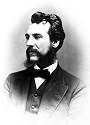
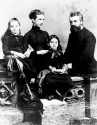
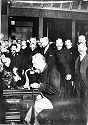
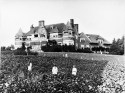
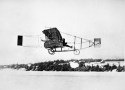
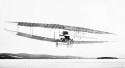
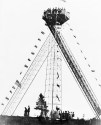
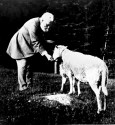
In 2007 we visited the Alexander Graham Bell Museum in Baddeck, Nova Scotia. It is a historical site in Canada and one of the finest museums I have seen. The Bell family donated all the items that are artfully displayed in the museum. There is a 15 minute video presentation that depicts the accomplishments of this great man.
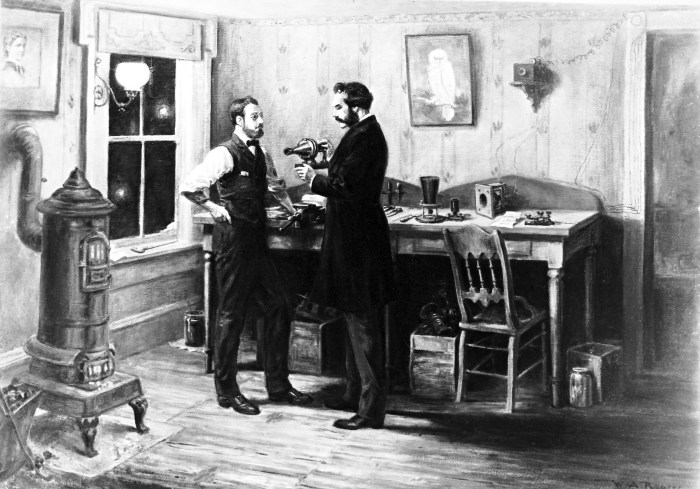
The painting shown above illustrates Alexander Graham Bell working with his assistant, Mr. Watson on the invention of the telephone. Bell had the idea for a speaking device for a long time, but it was just by accident they found a way to realize that dream. They developed the idea and Bell filed the patent paperwork on February 14, 1876, just hours before Elisha Gray was ready to file his patent for the telephone. Some people say Elisha Gray is really the inventor of the telephone because his patent was for a better working model than the one Bell had filed.
The first words heard over the telephone were, "Mr. Watson - Come here- I want to see you." Then they switched places and Mr. Watson said, "Mr. Bell, do you understand what I say?"
His fiancee, Mabel insisted he show his new telephone at the Centennial celebration in Philadelphia. When Dom Pedro the emperor of Brazil heard Bell reciting Shakespeare over the transmitter, he was astounded. Such a crowd gathered around the exhibition the police were summoned. Later President Rutherford B. Hayes was quoted as saying, "That's an amazing invention, but who would ever want to use one of them?" Later on he had one installed and called it "the greatest invention since the creation". His first call was to Alexander Graham Bell.
They approached Western Union about using their telegraph wires, but the officials there thought it was just a toy and turned them down. It was a bad decision they would regret. They later tried to compensate for it by partnering with Elisha Gray and Thomas Edison, and they began installing another telephone design across the country. Bell sued, and over the next twenty years was able to meet all challenges to his patent.
Bell and Watson took the show on the road, and people became interested in the telephone. The Bell Telephone Company was formed, and for a wedding gift Alexander would give his bride thirty percent share in the company. It would later become AT&T. Nineteen-year-old Mabel would be a wealthy woman.
About forty years later, by 1915 telephone lines would cross the entire North American continent.
Thomas Watson, Bell's assistant, was born in Salem, Massachusetts. When he was eighteen he started working at a machine shop. He was an excellent machinist and was just the man Bell needed when he started looking for an assistant. He was twenty years old at the time. After helping Bell invent the harmonic telegraph and the telephone he went on to other ventures. He had the largest shipbuilding business in America and became a wealthy man. He never stopped learning. He studied geology and paleontology, and later in life he even became an actor and wrote plays. He was quite a versatile man.
 A frequent question:
"Who wrote this biography
and when was it written?"
Look on this
Reference Citations Chart.

Work a Jigsaw Puzzle
Biography of Alexander Graham Bell
Garden of Praise has been granted permission to present these images for your benefit.
Please do not copy or use them without permission .
You can contact the Parks Canada Agency for permissions.
The reference book for the facts on these pages was the book below by Mary Kay Carson.
Conquests of Invention online book by Mary R. Parkman, 1921
Chapter about Alexander Graham Bell begins on page 379
Beginnings of the Telephone online book chapter by Alexander Graham Bell, 1906